
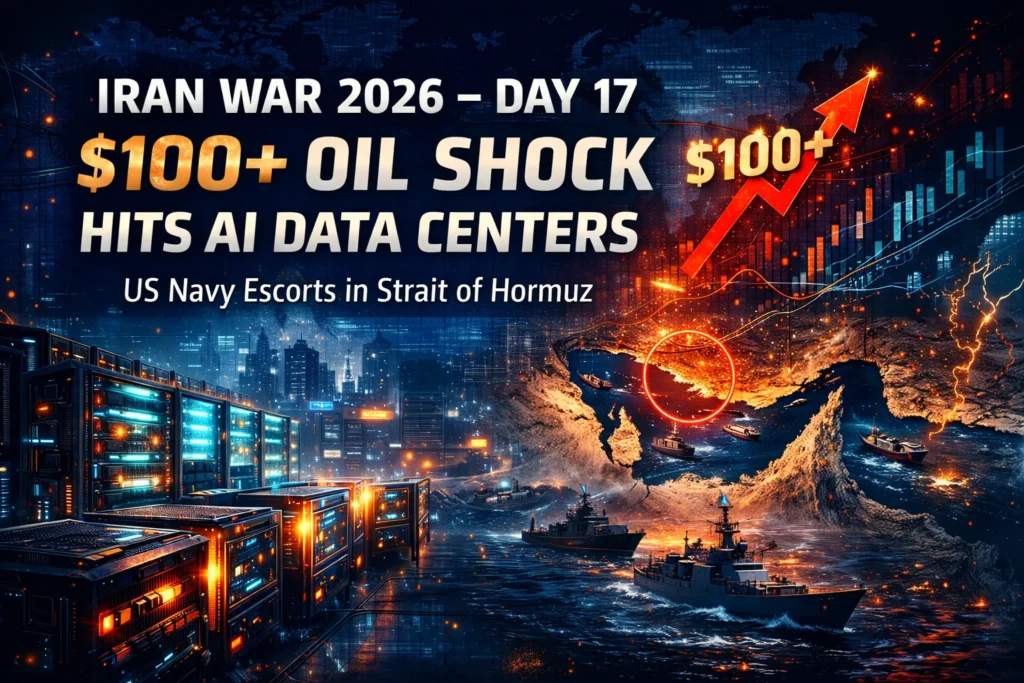
Iran War Day 17 – Latest Update and Why It Matters for US AI Infrastructure
The Iran war AI data center energy costs USA 2026 discussion has rapidly moved from niche analysis to a serious concern across technology, energy, and national security circles. As of Day 17 of the Iran conflict on March 15, 2026, military activity around the Persian Gulf has intensified, and the strategic Strait of Hormuz remains heavily disrupted. Oil markets have reacted sharply, with Brent crude hovering around $100–$103 per barrel after earlier spikes approaching $119. While the global focus remains on military escalation and diplomatic responses, another consequence is quietly unfolding: rising energy prices could significantly impact AI data center expansion in the United States.
Recent reports indicate that the United States has conducted targeted strikes near Iran’s Kharg Island, a critical export hub responsible for a large portion of the country’s oil shipments. While officials have stated that direct oil infrastructure damage was avoided, the operation sent shockwaves through energy markets. Iran has responded with a series of retaliatory actions across the region, including drone and missile activity targeting Gulf shipping routes and security installations. Some attacks reportedly struck near diplomatic compounds in Baghdad, further raising tensions.
Meanwhile, the Strait of Hormuz remains partially blocked or severely restricted, creating massive uncertainty in global shipping routes. Energy analysts estimate that over 150 vessels are currently delayed or rerouted, while insurance premiums for tankers have surged to record levels. In response, U.S. officials are discussing naval escort operations with allied fleets including the UK, France, and Japan to ensure safe passage for oil shipments.
At first glance, this conflict might appear unrelated to the American technology industry. Yet the connection becomes obvious when examining how AI infrastructure energy consumption and hardware efficiency affect long-term technology growth. Modern hyperscale facilities already face rising AI infrastructure memory and energy costs as compute demand increases.
Modern AI data centers require enormous electricity to power thousands of GPUs and advanced cooling systems. Some experimental projects are even exploring AI data centers in space to reduce cooling and energy constraints on Earth.
. If oil and natural gas prices remain volatile due to war, electricity tariffs across the United States especially in regions hosting large data center clusters could rise dramatically.
In fact, as discussed in our Day 16 update on oil surge impacts on AI infrastructure, the combination of higher fuel costs and disrupted supply chains could slow the pace of AI expansion worldwide.
Kharg Island Strikes and Escalation Signals
Kharg Island has long been considered one of Iran’s most strategically important oil export terminals. Located in the northern Persian Gulf, the facility handles a large share of Iranian crude shipments to international markets. Any military activity near this location automatically triggers concern in global energy markets.
During the latest phase of the conflict, U.S. forces reportedly conducted strikes targeting military installations connected to Iranian naval operations. According to official statements, the objective was to reduce Iran’s capacity to threaten shipping lanes in the Gulf rather than directly damage energy infrastructure. Nonetheless, the geopolitical message was unmistakable: control of energy transit routes remains central to the conflict.
The reaction from financial markets was immediate. Oil traders priced in the risk that a full-scale blockade of the Strait of Hormuz could occur if tensions escalate further. Even limited disruption to oil exports from the Gulf region can drive large price swings because the region accounts for roughly one-fifth of global oil supply.
For the United States, this volatility affects more than gasoline prices. Many power plants still rely on natural gas or oil-based generation, meaning electricity costs can climb when fuel prices surge. Since AI data centers are among the largest industrial consumers of electricity, they are directly exposed to this risk. Rising demand for GPUs has also intensified the AI memory bottleneck that affects large-scale machine learning infrastructure.
Strait of Hormuz Disruptions and 150+ Ships Stranded
The Strait of Hormuz closure AI data centers discussion centers around one crucial fact: this narrow shipping channel handles nearly 20% of global oil trade and a significant portion of LNG shipments. When the strait becomes unstable or partially blocked, the entire global energy market feels the impact.
Current reports indicate that shipping traffic through the strait has slowed dramatically due to security concerns. Some tankers are waiting for naval protection before entering the corridor, while others are being rerouted entirely. Insurance costs for vessels traveling through the region have reportedly increased severalfold, reflecting the perceived risk of drone or missile attacks.
These disruptions translate into higher costs for oil transport and delivery. Energy companies pass those costs along the supply chain, eventually affecting electricity producers. For AI infrastructure operators in the United States, the result could be significantly higher power prices in the coming months.
US Navy Escorts & Strait of Hormuz Security Response
The potential deployment of US Navy escorts in the Strait of Hormuz has become a central topic in discussions about stabilizing global energy markets. Military planners are reportedly coordinating with allied nations to establish protected transit corridors for oil tankers passing through the Persian Gulf.
The proposal aims to ensure that commercial shipping can continue despite ongoing hostilities in the region. While similar escort operations have been conducted in past conflicts, the scale of today’s global energy demand means that even temporary disruptions could trigger long-term economic consequences.
International Coalition Plans to Secure Oil Transit
Reports suggest that the United States is working with NATO allies and regional partners to create a multinational naval coalition tasked with escorting tankers through high-risk areas. Countries including the United Kingdom, France, and Japan have expressed interest in participating in coordinated security operations.
If implemented successfully, the escort system could help restore some confidence in global oil markets. However, the presence of military vessels also highlights the severity of the current crisis. Markets remain nervous because any miscalculation or escalation could quickly lead to broader conflict.
For industries dependent on stable energy prices especially AI infrastructure this uncertainty remains a major concern.
Global Energy Supply Risk and Strategic Oil Reserves
Governments have also begun discussing the possible release of strategic petroleum reserves to stabilize energy markets. The International Energy Agency has previously coordinated such releases during supply shocks to prevent extreme price spikes.
However, analysts caution that strategic reserves can only provide temporary relief. If the Strait of Hormuz remains unstable for weeks or months, supply constraints could persist despite emergency stockpiles.
For the United States technology sector, prolonged volatility could influence long-term decisions about AI data center expansion and energy sourcing strategies.
Volatile Oil Prices and US Electricity Costs
Oil price volatility triggered by the Iran conflict is already beginning to ripple through electricity markets. While oil itself does not generate most U.S. electricity, it strongly influences natural gas prices and overall energy market sentiment.
Brent Crude Timeline During the Iran War
The timeline of oil prices during the conflict illustrates just how quickly geopolitical events can reshape markets:
| Period | Brent Oil Price | Key Event | Electricity Impact |
|---|---|---|---|
| Pre-War (Jan 2026) | ~$73–$82 | Stable supply | Baseline |
| Early Conflict | ~$90–$110 | Gulf tensions escalate | +15–30% |
| Peak Volatility | Up to $119 | Shipping disruptions | +30–40% |
| Day 17 (March 15) | ~$100–$103 | US escort discussions | +30–50% projected |
PJM and ERCOT Power Costs for AI Data Centers
The United States hosts several major AI data center clusters, particularly in regions served by electricity markets such as PJM (Virginia) and ERCOT (Texas). These regions attract hyperscale cloud infrastructure due to reliable power grids, favorable regulations, and proximity to major internet exchange points.
However, both regions rely significantly on natural gas-fired power plants. If fuel costs rise due to global energy market disruptions, electricity prices for industrial customers including data centers could increase substantially.
Large AI data centers often consume 100 to 300 megawatts of electricity, equivalent to the power demand of small cities. Even modest increases in electricity tariffs can therefore translate into millions of dollars in additional annual operating costs.
Threats to US AI Data Center Expansion
The long-term concern for the technology industry is not just rising electricity prices but uncertainty about future energy availability. AI infrastructure requires massive upfront investment, and companies typically plan data center projects years in advance.
Hyperscaler Expansion Plans Facing Uncertainty
Major cloud providers including Amazon, Microsoft, and Google are currently expanding AI infrastructure across the United States. These projects involve multi-billion-dollar investments in new facilities equipped with thousands of GPUs that rely on high bandwidth memory for AI workloads to process massive datasets efficiently.
However, volatile energy markets complicate planning. Companies must sign long-term power purchase agreements (PPAs) with utilities to ensure reliable electricity supply. If energy prices become unpredictable due to geopolitical conflicts, these agreements become more expensive and harder to negotiate.
Middle East Cloud Regions and Drone Strike Risks
Another factor affecting the U.S. AI ecosystem is the security of cloud infrastructure located in the Middle East. Data centers operated by major providers in regions such as Bahrain, the UAE, and Qatar support global cloud workloads.
Drone and missile threats linked to the Iran conflict have raised concerns about infrastructure reliability. Even temporary outages in these regions could require rerouting workloads to U.S. data centers, increasing operational costs.
Semiconductor Supply and Helium Shortage Concerns
Energy disruptions can also affect the semiconductor manufacturing supply chain. AI chips rely on specialized gases including helium used in advanced chip fabrication processes. If LNG production and industrial gas supply chains are disrupted in the Middle East, semiconductor manufacturing could experience additional pressure.
This would raise costs for GPUs and AI accelerators, further increasing the overall cost of deploying large-scale AI infrastructure.
Renewable Energy Push for AI Infrastructure
Ironically, the current energy crisis may accelerate the transition toward renewable-powered data centers. Many hyperscalers have already committed to running their infrastructure on 100% carbon-free energy in the coming decade by investing in sustainable AI hardware and renewable-powered data centers.
Solar, wind, and hydroelectric power offer one key advantage over fossil fuels: their operating costs are relatively stable once infrastructure is built. As geopolitical tensions make oil and gas markets more unpredictable, renewable energy becomes increasingly attractive for powering AI workloads.
Companies such as Google and Microsoft are investing billions into renewable energy projects specifically designed to support their data center operations. These initiatives aim to create a more resilient energy foundation for the future of artificial intelligence.
How US Businesses Can Reduce AI Energy Costs During the Crisis
Businesses relying on AI infrastructure can take several steps to manage rising energy costs during periods of geopolitical instability.
First, organizations should focus on optimizing AI workloads. Many companies deploy models that are larger than necessary for their applications. Switching to smaller or more efficient models can significantly reduce compute requirements.
Second, businesses can schedule heavy training workloads during off-peak electricity periods, when energy tariffs are lower.
Third, investing in energy-efficient hardware architectures can reduce electricity consumption per unit of compute performance.
Finally, adopting hybrid computing architectures that combine cloud and edge computing can distribute workloads more efficiently and reduce reliance on expensive hyperscale compute clusters.
Conclusion – Geopolitics, Energy Security, and the Future of AI
The Iran War 2026 Day 17 update highlights how deeply interconnected global technology and energy systems have become. Artificial intelligence may seem like a purely digital industry, but its infrastructure depends on massive amounts of electricity and complex supply chains.
As tensions around the Strait of Hormuz continue to disrupt global oil markets, the ripple effects are reaching far beyond the energy sector. Rising electricity costs, infrastructure security concerns, and semiconductor supply chain disruptions could reshape the pace of AI development.
The United States remains a global leader in artificial intelligence innovation, but sustaining that leadership will require stable energy infrastructure and resilient supply chains. Whether through renewable energy investment, improved hardware efficiency, or strategic planning, the technology industry must adapt to a world where geopolitics increasingly influences digital infrastructure.
FAQs
How is the Iran war affecting AI data center energy costs in the USA?
The conflict has pushed global oil prices above $100 per barrel, increasing fuel costs for electricity generation. Since AI data centers consume massive amounts of power, rising electricity prices directly increase operating expenses.
Why is the Strait of Hormuz important for global technology infrastructure?
About 20% of the world’s oil supply passes through the strait. Disruptions there can raise energy prices globally, affecting electricity costs for industries like cloud computing and AI.
What role does the US Navy escort plan play in stabilizing oil markets?
Naval escorts aim to protect tanker shipments moving through high-risk waters. If successful, they could help restore confidence in energy markets and stabilize oil prices.
Could energy volatility slow AI development in 2026?
Yes. Higher electricity costs increase the price of training and running AI models. This could slow innovation for startups and smaller companies that lack large computing budgets.
Are renewable energy sources becoming more important for AI data centers?
Yes. Renewable power offers more stable long-term costs compared to fossil fuels, making it increasingly attractive for hyperscale data centers.
How can businesses reduce AI energy costs during energy crises?
Businesses can optimize workloads, use smaller AI models, schedule tasks during off-peak hours, and invest in more energy-efficient hardware systems.