
Introduction: Why SMBs Must Prioritize Cybersecurity in 2026
Cyber threats for small businesses in the U.S. are rising faster than ever in 2026. While large enterprises often have dedicated cybersecurity teams, SMBs remain prime targets due to limited IT budgets, fewer security protocols, and the misconception that “we’re too small to be targeted.” In reality, nearly 60% of small businesses experience a cyberattack each year, and many suffer significant financial loss, reputational damage, or operational disruption.
Why awareness matters:
- Data sensitivity: Even a small SMB stores client data, financial records, and intellectual property.
- Financial impact: Ransomware payments, downtime, and recovery can easily exceed $50,000 for SMBs.
- Regulatory risk: Compliance violations can trigger fines or lawsuits, even for small companies.
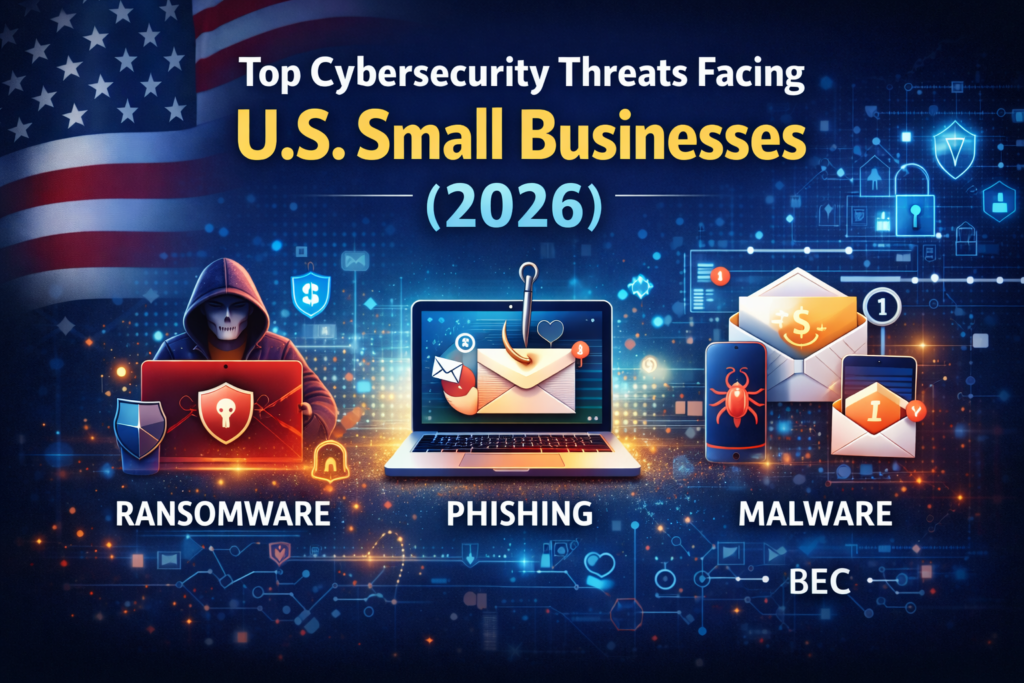
In this guide, we will explore the top cyber threats for U.S. small businesses in 2026, including ransomware, phishing, malware, and business email compromise (BEC). Each section includes real-world examples, practical prevention tips, and actionable insights that SMB owners, startup founders, and IT managers can implement immediately.
Ransomware Threats
Ransomware continues to be the most financially damaging cyber threat for SMBs. Attackers encrypt critical data and demand a ransom, often in cryptocurrency, to restore access.
How Ransomware Affects SMBs
Impact on SMBs:
- Operations can grind to a halt, particularly for businesses relying on digital records.
- Even if you pay the ransom, recovery is not guaranteed; some attacks result in permanent data loss.
Real U.S. Case Study:
- A small accounting firm in Texas was hit by ransomware in early 2025. Hackers encrypted all client files, demanding $75,000 in Bitcoin. Despite paying, 20% of files were unrecoverable due to corrupt backups.
Statistics:
- 43% of SMB cyberattacks in 2025 involved ransomware (Cybersecurity Ventures).
- Average downtime after a ransomware attack: 21 days.
- Average ransom payment for SMBs: $80,000–$120,000.
Network vulnerabilities such as unpatched systems, weak passwords, and lack of segmentation are primary enablers for ransomware attacks.
Prevention Tips
Best practices to mitigate ransomware risk:
- Regular Backups: Maintain offline and cloud backups. Test recovery regularly.
- Patch & Update Systems: Ensure all operating systems, apps, and firmware are current.
- Network Segmentation: Isolate critical systems so that malware cannot easily spread.
- Endpoint Protection: Deploy advanced antivirus and anti-ransomware tools.
- Employee Training: Educate staff on suspicious emails and unsafe downloads.
Phishing Attacks
Phishing remains one of the most common cyber threats small businesses face in 2026. Attackers exploit human psychology to trick employees into revealing sensitive information, clicking malicious links, or installing malware.
Common Phishing Techniques
Email Phishing:
- Fraudulent emails impersonate vendors, banks, or even internal executives.
- Example: An SMB received an email appearing to be from its payroll provider asking for login credentials. The email contained a malicious link, leading to a data breach.
SMS (Smishing) & Voice (Vishing):
- Employees may receive SMS messages claiming “urgent account verification needed” or phone calls from fake IT support.
Social Media Phishing:
- Attackers exploit LinkedIn or Facebook to send personalized messages that trick employees into sharing credentials.
Statistics:
- 91% of successful cyberattacks begin with phishing (FBI IC3, 2025).
- SMBs are increasingly targeted due to fewer security protocols.
Detection & Prevention
How SMBs can protect themselves:
- Employee Training: Conduct regular phishing simulations and awareness workshops.
- Email Filters & Security Gateways: Use AI-driven filters to block suspicious emails.
- Multi-Factor Authentication (MFA): Require MFA for all critical accounts to prevent unauthorized access even if credentials are compromised.
- Verification Protocols: Encourage staff to verify unusual payment requests or sensitive information requests via phone or video call.
Suggested Image:
- Alt text: “Phishing attack prevention for small businesses”
Malware & Trojans
Malware is malicious software designed to infiltrate, damage, or steal data from SMB networks. Unlike ransomware, malware can operate silently, exfiltrating sensitive data over time.
Types of Malware Targeting SMBs
- Viruses: Attach to legitimate files and spread to other systems.
- Spyware: Monitors employee activity and collects sensitive information.
- Trojans: Appear legitimate but install malicious payloads when executed.
- Ransomware variants: Combined malware types with encryption capabilities.
Best Practices for Protection
Recommendations for SMBs:
- Antivirus & Endpoint Protection: Deploy modern antivirus solutions across all devices.
- Regular Scanning: Schedule automated malware scans to detect infections early.
- Network Monitoring: Monitor unusual activity to identify potential intrusions.
- Software Whitelisting: Allow only approved software to run on critical systems.
- Employee Awareness: Ensure staff avoid downloading unknown software or opening unverified email attachments.
Business Email Compromise (BEC)
Business Email Compromise (BEC) is a growing threat that targets SMBs by exploiting trust and social engineering rather than technical vulnerabilities. Attackers often impersonate executives or trusted partners to trick employees into transferring funds or sharing confidential information.
How BEC Happens
Common BEC Scenarios:
- CEO Fraud: Employees receive an email appearing to be from the CEO requesting an urgent wire transfer.
- Vendor Email Compromise: Attackers hack or spoof a vendor’s email to redirect payments to fraudulent accounts.
- Account Takeover: Employee email accounts are compromised, and attackers use them to send authentic-looking fraudulent instructions.
Real-World Example:
- In 2025, a small manufacturing company in California lost $120,000 after an attacker impersonated their supplier via email, requesting immediate payment for “urgent materials.”
Key Risk Factors:
- Lack of MFA on email accounts
- Insufficient verification procedures for financial transactions
- Limited employee awareness about BEC schemes
Prevention Strategies
How SMBs can reduce BEC risk:
- Multi-Factor Authentication (MFA): Require MFA on all employee and executive email accounts.
- Employee Awareness Training: Regularly educate staff on social engineering tactics and verification procedures.
- Email Security Tools: Implement email filters that detect spoofing and domain anomalies.
- Verification Policies: Require secondary verification (call or video) for unusual payment requests.
- Regular Audits: Monitor email logs and unusual financial transactions to detect potential compromises early.
Actionable Cybersecurity Checklist for SMBs
Key Steps to Protect Your Small Business
- Regular Data Backups
- Maintain offline and cloud backups. Test them periodically to ensure recovery in case of ransomware or accidental deletion.
- Patch & Update Systems
- Keep operating systems, software, and firmware updated to fix vulnerabilities before attackers can exploit them.
- Deploy Multi-Factor Authentication (MFA)
- Protect all email, cloud, and critical business accounts with MFA to prevent unauthorized access even if credentials are stolen.
- Employee Cybersecurity Training
- Conduct phishing simulations, social engineering awareness, and regular workshops to empower staff to recognize threats.
- Endpoint Protection & Antivirus
- Install modern endpoint security solutions across all devices and run scheduled scans to detect malware or suspicious activity.
- Network Segmentation
- Isolate sensitive systems to limit the spread of malware or ransomware within your network.
- Email Security Filters
- Use AI-driven email gateways to block phishing, BEC, and spoofing attempts before they reach employees.
- Regular Risk Assessments
- Identify network vulnerabilities, critical assets, and potential threats with periodic risk assessments.
- Incident Response Plan
- Develop and document a response plan to handle cyber incidents quickly, minimizing downtime and damage.
- Strong Password Policies
- Require complex passwords, change them regularly, and avoid password reuse across systems.
- Secure Remote Access
- Implement VPNs, Zero Trust access, and endpoint monitoring for employees working remotely.
- Limit Admin Privileges
- Grant access only to employees who need it; monitor and audit privileged accounts regularly.
- Cyber Insurance
- Consider policies covering financial loss, ransomware payments, and business interruption.
- Vendor & Supply Chain Security
- Vet suppliers for cybersecurity standards and include requirements in contracts to prevent indirect breaches.
- Regular Audits & Monitoring
- Continuously monitor logs, system activity, and network traffic for unusual patterns or early signs of attack.
Conclusion
Cybersecurity threats for small businesses in the U.S. are more sophisticated than ever in 2026. From ransomware and phishing to malware and business email compromise, attackers exploit both technology gaps and human error.
Key Takeaways:
- Ransomware can shut down operations and cause permanent data loss; backups and patching are essential.
- Phishing attacks target employees through email, SMS, and social media; training and MFA are critical defenses.
- Malware and Trojans silently steal sensitive data; endpoint protection and monitoring reduce risks.
- BEC relies on social engineering; verification policies and email security tools protect your finances.
Actionable Next Steps for SMB Owners:
- Implement the cybersecurity checklist for small businesses USA immediately, starting with backups, patching, and MFA.
- Conduct employee awareness training quarterly to reduce human error.
- Regularly assess your network vulnerabilities and review incident response plans.
- Consider cyber insurance to mitigate financial risks in case of a breach.
- Continuously monitor emerging threats and adopt best practices to stay proactive rather than reactive.
By taking these steps, SMBs can significantly reduce their risk, protect sensitive data, and maintain customer trust. Remember, no business is too small to be targeted, and preparedness is your strongest defense.
FAQs
What emerging cyber threats should SMBs be aware of in 2026?
Beyond traditional phishing and ransomware, SMBs should watch for AI-driven phishing campaigns, deepfake email scams, IoT device vulnerabilities, and cloud misconfigurations that can expose sensitive data.
How does AI impact cybersecurity for small businesses?
AI can both help and hurt SMB cybersecurity. Attackers use AI to craft more convincing phishing emails, while businesses can leverage AI for threat detection, automated monitoring, and real-time alerts to prevent attacks.
Can small businesses survive a ransomware attack without paying the ransom?
Yes, if they have proper backups, offline storage, and an incident response plan. SMBs that rely on proactive recovery measures often restore operations without paying attackers, saving money and avoiding further risk.
Are small businesses required to comply with federal cybersecurity guidelines?
While not all SMBs are legally mandated, following CISA, FTC, and NIST guidelines helps reduce risk, improve customer trust, and may be required if handling financial or sensitive data for clients.
How can SMBs prioritize cybersecurity investments with limited budgets?
Focus on high-impact, low-cost measures first, like multi-factor authentication, employee training, regular backups, endpoint protection, and phishing simulations. Incrementally invest in advanced tools as the business grows.