
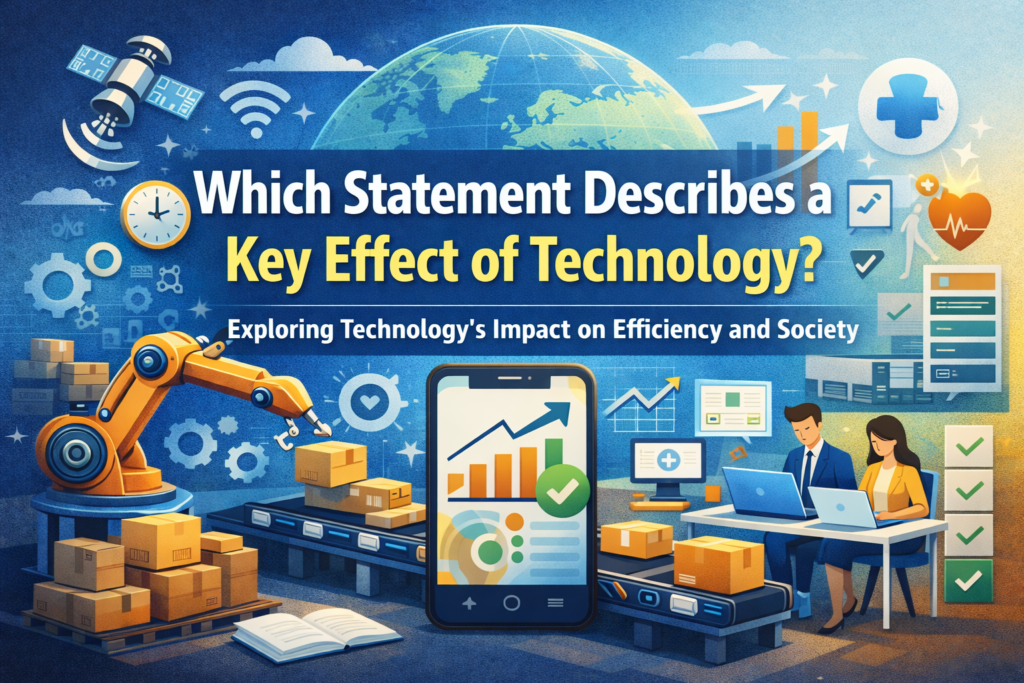
Which Statement Describes a Key Effect of Technology?
A correct statement describing a key effect of technology is that it increases efficiency by making tasks faster, easier, and more accurate.
This statement is considered correct because it applies to almost every form of technology. Whether technology is used in education, business, healthcare, or daily life, its most consistent result is improved efficiency. Efficiency means completing tasks in less time, with less effort, and with fewer mistakes. Technology does not change human goals, but it changes how those goals are achieved. Tools and systems help people perform activities more smoothly and reliably.
In exams, this statement is preferred because it is general, factual, and universally valid. It avoids opinion-based language and focuses on measurable outcomes. This makes it the safest and most accurate answer in assessments.
What Is Meant by the Effect of Technology?
The effect of technology refers to how tools and systems change the way people work, communicate, and live.
An effect is simply a result or outcome. In the context of technology, it means the changes created by using tools, machines, or digital systems. These changes can be functional, such as faster work, or social, such as new methods of communication. Technology affects productivity, access to information, and daily routines.
The effect of technology is not limited to one field. It appears in workplaces, schools, homes, and communities. Understanding these effects helps explain why technology plays an important role in modern society.
Why Efficiency Is Considered the Key Effect of Technology
Efficiency is considered the key effect of technology because it reduces time, effort, and errors in tasks.
Efficiency combines three elements: speed, accuracy, and better use of resources. Technology allows tasks to be completed faster through automation and digital tools. Accuracy improves because systems reduce human error. Resources such as time, energy, and materials are used more effectively.
These improvements appear wherever technology is used. In education, learning becomes more organized. In business, operations become smoother. In daily life, routine tasks require less effort. Because efficiency appears consistently across all uses of technology, it is identified as the key effect rather than a minor benefit.
Key Areas Where Technology Shows Its Effects
Technology shows its effects most clearly in work, communication, education, and daily life.
These areas highlight how technology changes both processes and outcomes in practical ways.
Technology in Work and Productivity
Technology improves productivity by automating tasks and organizing information.
Digital tools reduce repetitive work. Software systems manage data accurately. Communication within workplaces becomes faster. Employees complete tasks more efficiently, and productivity increases through better organization and time management.
Technology in Communication
Technology improves communication by enabling instant and reliable information exchange.
Messages can be shared immediately, regardless of distance. Information reaches large audiences quickly. Delays and misunderstandings are reduced, which improves coordination and collaboration.
Technology in Education
Technology improves education by increasing access to learning resources.
Online platforms provide information instantly. Digital tools support different learning styles. Educational efficiency improves because content is structured and easily accessible. Students and teachers save time.
Technology in Daily Activities
Technology simplifies daily activities by reducing effort and saving time.
Online services replace manual processes. Household devices improve convenience. Everyday tasks become easier to manage, showing the direct impact of technology on daily life.
Positive Effects of Technology
The positive effects of technology include increased productivity, better communication, and improved access to information.
Technology supports education by expanding learning opportunities. Healthcare benefits from accurate tools and systems. Businesses improve efficiency and reliability. Daily convenience increases through digital services.
These effects are observable and measurable. They result from practical application rather than theory. When used properly, technology enhances quality of life and supports social and economic development.
Negative Effects of Technology
Technology can also have negative effects such as dependency, privacy risks, and reduced physical activity.
Dependency occurs when people rely too heavily on technological systems. Privacy risks arise from data collection and online platforms. Reduced physical activity often results from extended screen use.
Technology itself remains neutral. Outcomes depend on how it is used. Acknowledging negative effects creates a balanced understanding and strengthens credibility. This neutral approach aligns with E-E-A-T principles. To understand this topic more clearly, it is important to examine the positive and negative effects of technology in everyday life and education.
Why This Question Is Common in Exams
This question is common in exams because it tests understanding of the basic impact of technology.
Exams focus on core concepts rather than specific examples. The effect of technology is a foundational topic in education. Multiple-choice questions often include opinion-based options, but efficiency stands out as a factual answer.
This question tests conceptual clarity instead of memorization. Understanding why efficiency is correct helps students avoid confusion during assessments.
Correct Statement for Exams and Assessments
The correct exam-ready statement is that technology increases efficiency and improves how tasks are performed.
This statement is short, general, and universally applicable. It avoids specific cases that may not apply everywhere. Examiners prefer such statements because they remain correct across different subjects and contexts.
Real-Life Examples of the Effect of Technology
Real-life examples show that technology improves efficiency in workplaces, schools, and homes.
In offices, software tools manage tasks and communication. In schools, digital platforms support structured learning. At home, online services save time and effort. Tasks that once took hours now take minutes.
These examples support theoretical explanations and show how technology affects everyday situations.
Why Understanding the Effect of Technology Matters
Understanding the effect of technology helps people use it responsibly and effectively.
Awareness leads to better decision-making. People can choose tools based on real needs. Responsible use reduces negative outcomes such as overdependence. This understanding benefits students, professionals, and society as a whole.
Final Summary
In summary, the key effect of technology is increased efficiency that improves work, communication, and daily life.
Technology consistently reduces effort and time while improving accuracy. Its effects are measurable and observable, making efficiency the most reliable and widely accepted impact of technology.
FAQs
Technology increases efficiency by making tasks faster and more accurate.
Because it reduces time, effort, and errors across most activities.
No, technology has both positive and negative effects depending on how it is used.