
What Happens When Production Technology Improves?
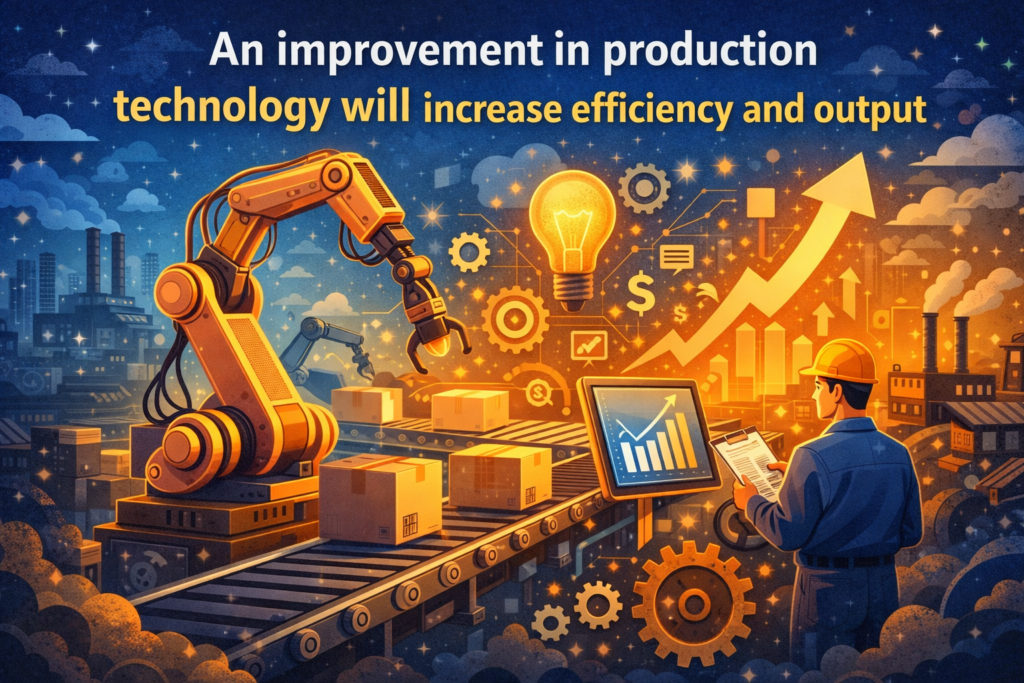
An improvement in production technology will increase output while reducing production time and cost.
Production technology refers to the tools, machines, techniques, and systems used to manufacture goods and services. When production technology improves, the entire production process becomes faster, more accurate, and more reliable. Advanced machines can perform tasks with precision, which reduces errors and material waste. As a result, industries are able to produce more goods within the same time period. Improved technology also reduces delays and interruptions in production. These changes allow firms to operate more efficiently and competitively. In economics and industrial studies, this outcome is considered a fundamental effect of technological progress in production.
How Production Technology Improves Efficiency
Improved production technology increases efficiency by automating processes and reducing human error.
Efficiency means completing tasks using fewer resources and less time. Automation plays a major role in improving efficiency by replacing repetitive manual work with machine-based systems. Machines can work continuously without fatigue, which ensures consistent performance. Production lines become smoother and more predictable when automated systems are used. Monitoring tools and sensors help identify problems early, reducing downtime. Digital systems also improve coordination between different stages of production. As a result, efficiency becomes measurable through faster output and improved reliability. This direct relationship explains why technology is closely linked with efficiency in production.
Effects on Cost and Productivity
Better production technology lowers costs and increases productivity for businesses.
Production costs decrease when advanced technology reduces material waste and energy consumption. Automated systems require fewer manual interventions, which lowers labor-related expenses. At the same time, productivity increases because more goods are produced within shorter timeframes. Higher productivity allows firms to meet market demand more effectively. It also improves competitiveness by enabling businesses to offer products at lower prices. Over time, reduced costs and increased productivity support sustainable growth. These economic benefits are key reasons why firms invest in improved production technology.
Impact on Workers and Industry
Advancements in production technology increase automation and demand for skilled labor.
As automation increases, repetitive manual jobs may decline. However, demand grows for skilled workers who can operate, manage, and maintain advanced production systems. Employees are required to develop technical and problem-solving skills. Industries shift their focus toward innovation, efficiency, and quality control. Training and education become more important as job roles evolve. Instead of eliminating work entirely, production technology transforms the nature of employment. This structural change affects industries globally and influences labor policies and workforce planning.
Real-World Examples of Improved Production Technology
Examples of improved production technology include robotics, automation, and advanced manufacturing systems.
Robotics is commonly used in assembly lines to increase precision and speed. Automated systems manage production flow, inventory, and quality control. Advanced manufacturing uses data analytics, artificial intelligence, and smart machines to optimize production processes. These technologies reduce errors and increase output consistency. Many industries adopt such systems to remain competitive in global markets. Real-world applications confirm the theoretical benefits discussed in economics. These examples demonstrate how production technology functions in practice and delivers measurable results.
Final Economic Summary
In summary, improvements in production technology lead to higher efficiency, lower costs, increased productivity, and economic growth.
Production technology directly affects how industries operate and compete. Its improvement results in faster production, better quality, and reduced operational costs. Understanding this relationship is essential for students, economists, and business professionals. It explains why technological advancement is a key driver of industrial and economic development.
FAQs
Production becomes faster, more efficient, and less costly, leading to higher output.
It increases productivity by allowing more goods to be produced in less time using fewer resources.
Production technology is important because it reduces costs, improves efficiency, and supports economic growth.