
Introduction: The AI Data Center Power Crunch
AI isn’t just transforming software. It’s reshaping the global energy landscape.
As generative AI models scale and enterprises deploy large language models across industries, AI data center energy demand is rising at a pace utilities weren’t designed to handle. Training and running advanced AI systems requires massive compute clusters powered by GPUs, high-bandwidth memory, and cooling systems that operate around the clock. A single hyperscale AI facility can consume as much electricity as a small city.
This growth is forcing Big Tech to rethink power procurement. It’s no longer enough to buy renewable energy credits or sign short-term power purchase agreements. The challenge now is reliability. Wind and solar are intermittent. Lithium-ion batteries help stabilize the grid for a few hours. But AI workloads don’t pause when the wind stops blowing.
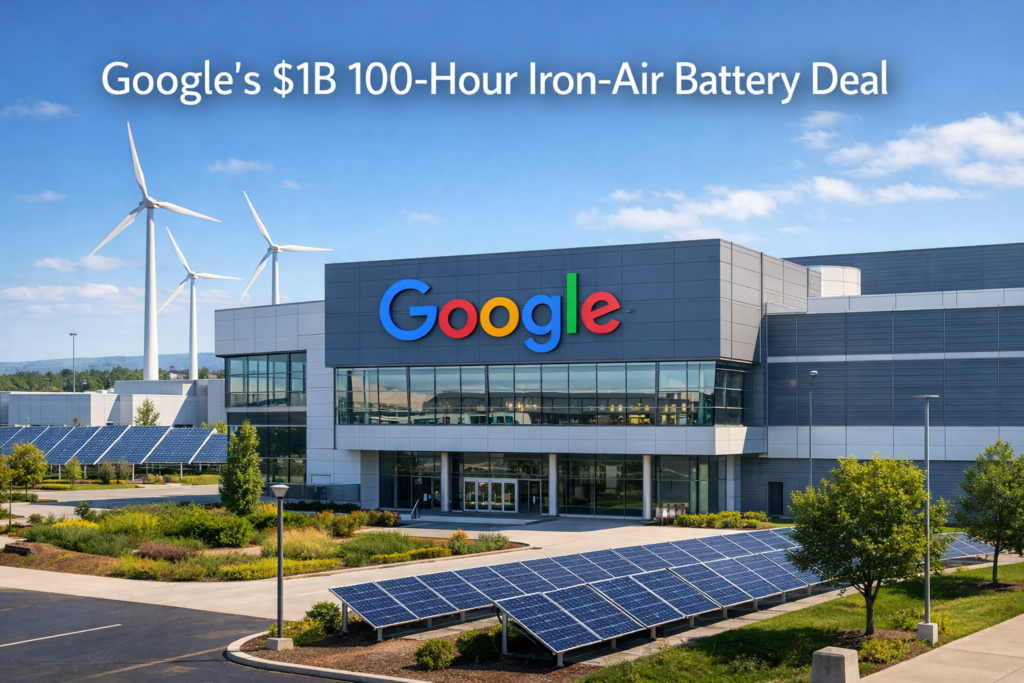
That’s the context behind Google’s reported $1 billion deal with Form Energy for a 100-hour battery system at its Minnesota data center. The agreement signals a deeper shift: long-duration energy storage is moving from experimental pilot projects to mission-critical infrastructure for hyperscale computing.
If AI is the engine of the next digital economy, long-duration batteries may be the fuel buffer that keeps it running.
What Google Announced
Google confirmed plans to deploy Form Energy’s iron-air battery technology to support its Minnesota data center operations. The facility will be powered primarily by wind and solar, with Form Energy’s storage system providing extended backup and grid stability.
Unlike conventional battery installations that offer four to eight hours of storage, this system is designed to deliver electricity continuously for up to 100 hours. That’s more than four days of backup capacity.
The Minnesota site is strategically important. The region has strong wind resources and expanding renewable infrastructure. However, seasonal variability especially during winter creates reliability concerns. Long-duration storage helps bridge those gaps without relying heavily on fossil fuel peaker plants.
For Google, this aligns with its long-standing goal of operating on 24/7 carbon-free energy across its global data center footprint. The company has invested heavily in renewable procurement, grid partnerships, and energy innovation. But achieving around-the-clock clean power requires storage that goes beyond lithium-ion.
The Form Energy partnership represents one of the largest commitments to long-duration energy storage by a hyperscale cloud provider. It also reflects a broader industry recognition: AI growth and sustainability goals must evolve together.
What Is Form Energy’s Iron-Air Battery and How It Works
Form Energy’s technology is based on one of the most abundant materials on Earth: iron.
The iron-air battery operates using a reversible rusting process. During discharge, iron reacts with oxygen from the air to form iron oxide essentially rust while releasing electricity. During charging, the system converts that rust back into iron by reversing the reaction.
The concept is chemically simple but operationally significant.
Here’s a simplified breakdown:
- Discharge phase:
- Iron metal oxidizes (rusts).
- Oxygen from the air participates in the reaction.
- Electrical energy is generated.
- Charge phase:
- An electrical current reverses the oxidation.
- Iron oxide converts back to metallic iron.
- The system resets for the next cycle.
Unlike lithium-ion batteries, which rely on more expensive and supply-constrained materials like lithium, cobalt, and nickel, iron-air batteries use low-cost and widely available inputs. That makes them potentially cheaper at scale.
The tradeoff? Lower energy density and slower response times compared to lithium-ion. But for grid-scale applications—especially multi-day backup energy density is less critical than cost and duration.
Form Energy’s system is specifically designed for multi-day storage, targeting grid resilience rather than short bursts of frequency regulation.
Why 100-Hour Storage Is a Big Deal
Most grid-connected lithium-ion batteries provide about four hours of storage. Some installations extend to eight hours. That’s sufficient for smoothing short-term fluctuations in solar production or managing peak demand.
But it’s not enough for prolonged weather events.
Consider scenarios like:
- Multi-day winter storms
- Extended periods of low wind
- Heatwaves that spike demand
- Regional grid stress events
In these cases, four-hour storage barely scratches the surface.
A 100-hour battery changes the equation. It enables:
- Multi-day renewable coverage
- Reduced reliance on natural gas peaker plants
- Greater grid resilience
- Improved integration of high renewable penetration
For AI data centers, the implications are strategic. Compute clusters cannot simply power down for days without operational and financial consequences. Long-duration storage offers a path to maintain uptime while staying aligned with carbon reduction goals.
From a cost perspective, lithium-ion becomes increasingly expensive as duration increases. The economics of iron-air batteries improve at longer durations, making them more competitive for multi-day storage.
In short, this isn’t about replacing lithium-ion. It’s about addressing a gap in the energy storage spectrum.
Multi-day storage is becoming essential for renewable-heavy grids. According to the U.S. Department of Energy’s Long Duration Storage Shot initiative, reducing storage costs is critical to making 24/7 carbon-free energy viable at scale.
How This Impacts AI Data Centers and Big Tech Energy Strategy
The Google Form Energy battery deal highlights a turning point in how hyperscalers approach infrastructure.
AI workloads are fundamentally different from traditional cloud services. Training large models can consume megawatt-scale power continuously for weeks. Inference at global scale requires stable, predictable electricity.
Recent data from the International Energy Agency’s energy storage report highlights how battery deployments are accelerating worldwide to support renewable integration and grid reliability.
At the same time, regulators and investors are scrutinizing Big Tech’s carbon footprint more closely than ever. Articles like our coverage on Sustainable AI Hardware and AI Hardware Carbon Footprint show how sustainability is becoming central to AI infrastructure planning.
Long-duration energy storage gives companies more control over:
- Grid dependency
- Carbon intensity profiles
- Energy price volatility
- Operational resilience
It also complements efficiency efforts discussed in pieces like AI Infrastructure Memory Energy Costs, where compute efficiency and energy strategy intersect.
Other tech giants including Microsoft, Amazon, and Meta are exploring advanced nuclear, geothermal, and long-duration storage solutions. The goal isn’t just to offset emissions; it’s to secure reliable, scalable power for AI expansion.
Google’s move signals that long-duration storage is transitioning from experimental to enterprise-grade.
Investment, Funding, and IPO Plans
Form Energy has raised significant funding from investors including Breakthrough Energy Ventures, Coatue, and others focused on climate technology. The Google partnership strengthens Form Energy’s commercial credibility.
According to BloombergNEF’s coverage of Google’s energy strategy, investment in advanced long-duration storage systems and other innovative energy technologies is expected to scale rapidly in 2026.
The Google partnership strengthens Form Energy’s commercial credibility. Large-scale deployment with a hyperscale customer provides validation that utilities and institutional investors often look for before committing capital.
While Form Energy has not formally announced IPO timing, industry observers see growing momentum toward public market readiness particularly as demand for grid-scale storage expands.
Expansion plans include scaling manufacturing facilities in the U.S., which could align with federal incentives under clean energy legislation. Domestic production may also reduce supply chain risk compared to lithium-based systems.
For Google, the $1B commitment isn’t just a procurement decision. It’s a strategic investment in grid innovation.
Is Iron-Air the Future of Long-Duration Energy Storage?
Iron-air is unlikely to be the only solution in the long-duration storage market. Alternatives include:
- Flow batteries
- Compressed air energy storage
- Thermal storage
- Green hydrogen systems
Each technology addresses different cost, efficiency, and deployment tradeoffs.
Iron-air’s main advantages:
- Abundant materials
- Potentially lower cost at scale
- Multi-day discharge capability
Limitations include:
- Larger physical footprint
- Lower round-trip efficiency compared to lithium-ion
- Slower response time
For AI data centers that require both instantaneous backup and multi-day resilience, hybrid systems may emerge. Lithium-ion could handle short-term fluctuations, while iron-air manages extended outages.
The key question isn’t whether iron-air will dominate. It’s whether it becomes a standard component of grid-scale renewable infrastructure.
Given Google’s commitment, the market now has a high-profile proof point.
FAQs
What is the Google Form Energy battery deal about?
Google signed a $1B agreement with Form Energy to deploy a 100-hour iron-air battery at its Minnesota data center.
What makes a 100-hour battery different from lithium-ion?
Most lithium-ion systems provide 4–8 hours of storage. Iron-air batteries can deliver power for up to 100 hours.
Why do AI data centers need long-duration storage?
AI workloads run continuously and require reliable, carbon-free electricity even during multi-day renewable gaps.
Is iron-air battery technology commercially proven?
It is emerging technology, but large-scale deployments like Google’s signal growing enterprise confidence.
Will iron-air replace lithium-ion batteries?
Not entirely. It is better suited for long-duration applications, while lithium-ion remains strong for short-term storage.
Conclusion: AI’s Energy Future Depends on Storage Innovation
The AI boom has exposed a simple reality: computing power depends on energy infrastructure.
Google’s $1B deal with Form Energy underscores that AI data center energy planning must evolve beyond short-duration storage and carbon offsets. Multi-day resilience is becoming essential.
The 100-hour battery isn’t just an engineering milestone. It’s a strategic tool for enabling 24/7 carbon-free operations in a world where AI workloads run nonstop.
If this deployment succeeds, expect more hyperscalers to follow with similar long-duration storage partnerships. Iron-air may not replace lithium-ion, but it could redefine how renewable-powered data centers operate.
As AI scales, the conversation is shifting from chips and models to megawatts and storage hours. And in that shift, long-duration batteries are becoming core infrastructure not optional add-ons.