
Introduction: What Is AI-Powered SaaS and Why Small Businesses Should Care
Running a small business today is very different from even five years ago. Customers expect fast responses, personalized experiences, seamless online interactions, and professional service — whether they are buying from a global corporation or a local shop. The good news is that small business owners no longer need a large team or a massive budget to meet those expectations. Thanks to AI-powered SaaS (Software as a Service), powerful technology is now accessible to businesses of every size.
SaaS, or Software as a Service, refers to cloud-based software that you access through the internet instead of installing it on your computer or maintaining your own servers. Instead of paying thousands of dollars upfront for software licenses, businesses typically pay a monthly or annual subscription fee. Popular examples include tools like Salesforce for customer relationship management, QuickBooks for accounting, and Shopify for building online stores. These platforms eliminate the need for complex IT infrastructure, making advanced tools affordable and easy to manage.
Now, when artificial intelligence (AI) is added to SaaS platforms, the value increases dramatically. AI allows software to analyze data, learn from patterns, automate repetitive tasks, and even make predictions. Instead of manually sorting through leads, scheduling emails, forecasting sales, or responding to customer inquiries, AI-powered tools can handle much of that work automatically. For a small business owner juggling marketing, sales, operations, and customer service, this can feel like adding a digital assistant to the team.
One of the biggest misconceptions about AI is that it is only for large enterprises with deep pockets and dedicated data science teams. That used to be true. However, cloud computing and subscription-based pricing have completely changed the landscape. Today, even a solo entrepreneur can use AI tools that were once available only to corporations. Whether it’s automating email marketing, predicting inventory needs, screening job applicants, or generating content, AI-powered SaaS levels the playing field.
In this guide, you will learn exactly what AI-powered SaaS is, how it works in simple terms, and where it can make the biggest difference in your business. We will explore practical use cases across marketing, sales, customer support, finance, and operations. You’ll also discover how to choose the right tools, avoid common mistakes, and prepare your business for the future of AI-driven growth. By the end, you’ll have a clear roadmap for using AI SaaS to work smarter not harder.
Understanding SaaS Basics
For many small business owners, the concept of software can seem complicated. Terms like “cloud computing,” “multi-tenant architecture,” or “subscription model” can sound intimidating. The good news is that understanding SaaS doesn’t require a technical background. At its core, SaaS (Software as a Service) is simply software you access over the internet, and it has become a cornerstone of modern business operations.
What Is SaaS?
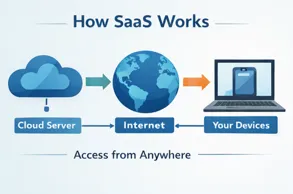
SaaS is a type of software that is hosted in the cloud and delivered over the internet. Unlike traditional software, which you install and maintain on individual computers or servers, SaaS is ready to use immediately through a web browser. This means no lengthy installation processes, no complicated server setup, and no manual updates. You simply log in, and the software works.
The subscription-based model of SaaS also makes it very affordable for small businesses. Instead of paying a large upfront cost for a software license, you pay a monthly or annual fee. This approach allows businesses to access powerful tools without heavy financial risk. For example, marketing automation platforms, accounting software, and project management tools often operate on a SaaS model, making them accessible to businesses of all sizes.
Another key advantage of SaaS is scalability. If your business grows, your SaaS subscription can often scale with you. Need more storage, extra users, or advanced features? Many SaaS providers allow you to upgrade plans seamlessly, avoiding the headache of migrating to new software.
How SaaS Works Behind the Scenes
While small business owners don’t need to become IT experts, understanding the basics of how SaaS works can be helpful. SaaS platforms run on cloud servers, which are managed and maintained by the provider. This setup means you don’t need your own server infrastructure or a dedicated IT team to keep the software running.
Updates and new features are handled automatically by the SaaS provider, ensuring that you always have access to the latest functionality. Security measures, including data encryption and regular backups, are also managed on the provider’s end, which reduces the risk of data loss or breaches. Many SaaS platforms operate on what’s called a “multi-tenant architecture,” which allows multiple customers to share the same software environment while keeping data private and secure.
Additionally, SaaS tools often integrate easily with other software you already use. This interoperability ensures that your marketing, sales, accounting, and operations tools can work together, creating a seamless workflow across your business.
Benefits of SaaS for Small Businesses
SaaS offers several advantages that are particularly important for small businesses:
- Lower Upfront Costs: Pay-as-you-go pricing reduces financial barriers and helps preserve cash flow.
- Scalability: As your business grows, you can upgrade plans without needing a complete software overhaul.
- Remote Access: SaaS tools are cloud-based, allowing you and your team to work from anywhere.
- Automatic Updates: No need to manually install updates or worry about software becoming obsolete.
- Reduced IT Burden: The SaaS provider handles server management, maintenance, and security.
- Integration with Other Tools: Many SaaS solutions connect with popular platforms like email, CRM, and accounting software, streamlining operations.
By adopting SaaS, small business owners gain access to enterprise-level technology at a fraction of the cost and complexity, freeing up time to focus on growth and customer engagement rather than software management.
This section lays the groundwork so readers can confidently understand what SaaS is and why it matters before we dive into AI-specific capabilities.
What Makes SaaS “AI-Powered”?
Artificial intelligence (AI) has become one of the most talked-about technologies in business today. But for many small business owners, AI can feel intimidating or overly technical. The truth is, you don’t need to be a data scientist to benefit from AI. When AI is integrated into SaaS tools, it works quietly in the background to automate tasks, provide insights, and make your business operations smarter and more efficient.
What Is Artificial Intelligence in Simple Terms?
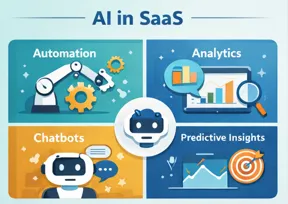
At its core, AI is the ability of software to perform tasks that would normally require human intelligence. This can include:
- Machine Learning: AI systems learn from data patterns to make predictions or improve performance over time. For example, an AI tool might analyze past sales to predict which products are likely to sell best next month.
- Automation: AI can handle repetitive tasks automatically, such as sending follow-up emails or categorizing customer inquiries.
- Predictive Analytics: AI can forecast future trends based on historical data, helping businesses make informed decisions.
- Natural Language Processing (NLP): AI can understand and generate human language, powering tools like chatbots, automated emails, or content creation software.
These capabilities mean AI isn’t just about fancy algorithms it’s about practical applications that save time, reduce errors, and help your business grow smarter.
For a more detailed explanation of how AI technologies like machine learning and natural language processing function, this guide by IBM provides a clear and beginner-friendly overview.
How AI Enhances SaaS Tools
When combined with SaaS, AI transforms ordinary software into a proactive business partner. Here’s how:
- Automating Repetitive Tasks: AI can handle routine work like scheduling social media posts, sending reminders, or sorting customer support tickets.
- Smart Recommendations: AI can suggest actions, such as which leads to follow up with or which marketing campaigns are likely to perform best.
- Predicting Customer Behavior: AI tools analyze customer data to anticipate needs, helping you provide personalized experiences that improve satisfaction and retention.
- Real-Time Insights: AI continuously analyzes data and presents actionable insights, so you can make decisions faster and with more confidence.
Essentially, AI adds intelligence to SaaS tools, allowing them to do more than just store data or run tasks they start to think, learn, and assist.
Why AI Is Now Affordable for Small Businesses
Not long ago, AI technology was expensive and limited to large corporations. Today, AI-powered SaaS tools are accessible, affordable, and designed specifically for small businesses.
According to research by McKinsey & Company, AI adoption has accelerated rapidly across industries, including small and mid-sized businesses, as companies recognize its impact on productivity and growth.
- Cloud Computing Advancements: Cloud infrastructure allows AI tools to run efficiently without requiring powerful local hardware.
- Subscription-Based Pricing: Pay-as-you-go models make AI tools affordable and scalable, avoiding massive upfront costs.
- Increased Competition in the SaaS Market: More vendors are offering AI features tailored to small business needs, driving innovation and lowering prices.
The result is that small business owners can now leverage AI to automate tasks, gain insights, and improve decision-making all without hiring a specialized team.
By understanding how AI integrates with SaaS, small business owners can start seeing software not just as a tool, but as a smart assistant that helps them work more efficiently, save time, and grow their business.
Core Areas Where AI SaaS Helps Small Businesses
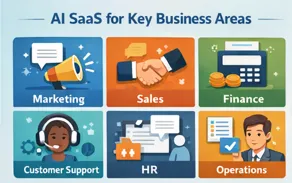
AI-powered SaaS isn’t just a futuristic conceptit’s a practical solution that small businesses can use right now. From marketing to finance, AI tools can streamline operations, improve customer experiences, and free up your time for strategic decisions. Let’s explore the main areas where AI SaaS delivers the biggest impact.
Marketing & Customer Acquisition
Marketing can be time-consuming, especially for small businesses with limited staff. AI-powered SaaS tools can make marketing smarter and more efficient.Especially when businesses use AI automation tools designed to save time and reduce manual work.
- Content Creation: AI writing assistants can generate social media posts, blog content, and email copy in minutes, saving hours of work.
- Email Marketing Automation: AI can segment your audience, schedule campaigns, and even personalize emails based on customer behavior.
- Social Media Management: AI tools analyze engagement data to suggest optimal posting times, hashtags, and content types.
- Customer Segmentation: By analyzing purchase history and interactions, AI identifies groups of customers with similar preferences for targeted campaigns.
- Ad Optimization: AI can automatically adjust advertising campaigns in real time to improve ROI, targeting the right audience with the right message.
For small businesses, these capabilities mean marketing can become more effective and less overwhelming, even with a limited team.
Sales & Customer Relationship Management (CRM)
AI can revolutionize how small businesses manage leads and sales pipelines by identifying high-quality prospects and improving lead targeting strategies.
- Lead Scoring: AI evaluates potential customers based on behavior and likelihood to purchase, helping sales teams prioritize effectively.
- Automated Follow-Ups: AI can send personalized messages to leads at the right time, improving conversion rates.
- Chatbots: AI-powered chatbots provide instant responses to customer inquiries, even outside business hours.
- Pipeline Forecasting: Predictive analytics help businesses anticipate sales trends and adjust strategies accordingly.
With AI, sales teams spend less time on manual tracking and more time on meaningful customer interactions.
Customer Support
Customer service can make or break a small business. AI SaaS tools enhance support efficiency and responsiveness:
- AI Chatbots: Handle common customer queries instantly, reducing wait times and support staff workload.
- Ticket Prioritization: AI identifies urgent issues, ensuring high-priority problems are addressed first.
- Sentiment Analysis: AI evaluates customer messages to detect frustration or satisfaction, enabling timely intervention.
- 24/7 Support: Even without a large support team, AI tools can provide around-the-clock assistance.
These tools not only improve customer experience but also save money on staffing.
Finance & Accounting
Managing finances manually is both time-consuming and prone to error. AI-powered SaaS can simplify financial operations:
- Automated Bookkeeping: AI categorizes transactions, generates reports, and reduces human errors.
- Expense Tracking: Automatically tracks and categorizes expenses, making budgeting easier.
- Fraud Detection: AI identifies unusual transactions or patterns to protect your business.
- Cash Flow Forecasting: Predictive analytics help small business owners plan ahead and avoid cash flow shortages.
AI transforms finance from a tedious task into a strategic advantage, helping businesses stay on top of their finances.
HR & Hiring
Finding and managing the right team is crucial for growth. AI SaaS tools can help streamline HR processes:
- Resume Screening: AI filters candidates based on qualifications and experience, saving hours of manual review.
- Employee Performance Insights: AI tracks productivity trends and identifies opportunities for improvement.
- Payroll Automation: AI ensures accurate payroll processing and reduces administrative errors.
- Scheduling Tools: AI optimizes employee schedules based on availability, workload, and predicted demand.
These tools make HR operations efficient and help small businesses build stronger, more productive teams.
Operations & Productivity
Operational efficiency is essential for small businesses to compete. AI-powered SaaS helps simplify everyday processes:
- Workflow Automation: Automates repetitive tasks, freeing employees to focus on higher-value work.
- Project Management Tools: AI predicts project timelines, assigns tasks intelligently, and monitors progress.
- Time Tracking: AI analyzes how teams spend time and identifies opportunities to improve productivity.
- Inventory Management: AI forecasts demand, suggests restocking times, and reduces overstock or stockouts.
By leveraging AI in operations, small businesses can work faster, reduce errors, and focus on growth.
AI-powered SaaS transforms every aspect of a small business from attracting customers to managing finances and streamlining operations. By automating repetitive tasks and providing actionable insights, these tools give small business owners more time to focus on strategy and growth.
Top AI-Powered SaaS Tools Small Businesses Should Consider
Choosing the right AI-powered SaaS tools can be overwhelming because the market is full of options. To make it easier, here’s a curated list of some of the most effective tools across different business functions, along with what they do and why they are valuable for small businesses.
AI Writing & Content Creation Tools
Jasper AI – AI writing assistant that helps create blog posts, social media content, ad copy, and emails.
- Best for: Small businesses needing fast, professional content.
- Key AI Features: Natural language generation, tone customization, content improvement suggestions.
- Pricing: Subscription-based, with different tiers depending on word count and features.
- Pros: Saves time, boosts content output, easy to use.
- Cons: Requires human review for accuracy and brand voice consistency.
Copy.ai – Focused on marketing copy and social media content generation.
- Best for: Small marketing teams or solo entrepreneurs.
- Key AI Features: AI templates for ads, blogs, and emails; automatic idea generation.
- Pricing: Free plan available; paid plans unlock advanced features.
AI-Powered CRM Platforms
HubSpot CRM – Comprehensive customer relationship management software with AI features.
- Best for: Small businesses looking for marketing, sales, and customer support integration.
- Key AI Features: Lead scoring, predictive analytics, email automation, and chatbots.
- Pricing: Free basic plan; paid plans add advanced AI tools.
- Pros: All-in-one solution, easy onboarding, scalable.
- Cons: Advanced features can be expensive.
Salesforce Essentials – Cloud-based CRM with AI-driven insights for small teams.
- Best for: Growing small businesses needing advanced reporting.
- Key AI Features: Predictive lead scoring, workflow automation, AI-powered recommendations.
- Pricing: Subscription-based with tiered plans.
- Pros: Highly customizable, industry-leading platform.
- Cons: Can have a learning curve for beginners.
AI Accounting & Finance Software
QuickBooks Online – Popular accounting platform with AI automation.
- Best for: Small businesses needing bookkeeping, invoicing, and financial insights.
- Key AI Features: Automatic transaction categorization, cash flow prediction, expense tracking.
- Pricing: Subscription-based with multiple tiers.
- Pros: Easy to use, integrates with banks, strong reporting features.
- Cons: Advanced features require higher-tier plans.
Xero – Cloud accounting software with AI-driven financial insights.
- Best for: Businesses with international clients or multiple currencies.
- Key AI Features: Automated invoice reconciliation, predictive cash flow, expense suggestions.
- Pricing: Monthly subscription with scalable plans.
AI Marketing Automation Tools
Mailchimp – Email marketing platform enhanced with AI features.
- Best for: Small businesses managing email campaigns and customer segmentation.
- Key AI Features: Predictive analytics, send-time optimization, audience segmentation.
- Pricing: Free plan for small lists; paid plans offer advanced AI features.
HubSpot Marketing Hub – Integrated marketing automation software.
- Best for: Businesses looking for a complete marketing solution.
- Key AI Features: Predictive lead scoring, AI-powered email personalization, analytics dashboards.
AI Customer Service Platforms
Zendesk – Customer support software with AI capabilities.
- Best for: Businesses wanting to improve support without increasing staff.
- Key AI Features: Chatbots, automated ticket routing, sentiment analysis.
- Pricing: Tiered subscription plans.
- Pros: Enhances response times, scalable.
- Cons: Advanced AI features require premium plans.
Intercom – Conversational AI platform for support and sales.
- Best for: SaaS companies or e-commerce businesses needing live chat and automation.
- Key AI Features: AI chatbots, workflow automation, customer insights.
AI Scheduling & Productivity Tools
Clockwise – AI-driven calendar assistant that optimizes schedules.
- Best for: Teams needing smarter time management.
- Key AI Features: Automatically schedules meetings, finds focus time, integrates with Google Calendar.
Trello with Butler AI Project management tool with AI automation.
- Best for: Teams managing tasks and projects efficiently.
- Key AI Features: Automates repetitive actions, sends notifications, organizes workflows.
By selecting the right combination of these tools, small businesses can harness the power of AI without adding extra staff or overwhelming complexity. Each tool provides a tangible benefit whether it’s saving hours of work, improving customer relationships, or boosting revenue through smarter marketing.
How to Choose the Right AI SaaS Tool for Your Business
With so many AI-powered SaaS tools available, small business owners can easily feel overwhelmed. It’s tempting to sign up for multiple platforms at once, especially when free trials and flashy features promise instant results. However, choosing the right tool isn’t about having the most technology it’s about selecting the right technology for your specific goals. A strategic approach will save you money, reduce complexity, and maximize return on investment.
Define Your Business Goals First
Before purchasing any AI SaaS tool, clearly define what problem you’re trying to solve. Are you looking to increase revenue? Reduce manual work? Improve customer satisfaction? Speed up hiring? Each goal requires a different type of tool.
For example, if your primary challenge is inconsistent lead follow-ups, an AI-powered CRM may be the right choice. If you’re spending too much time creating marketing content, an AI writing tool might be more valuable. By identifying your biggest bottleneck, you ensure the technology supports your strategy rather than distracting from it.
It’s also helpful to set measurable objectives. Instead of saying “I want better marketing,” aim for something like “Increase email open rates by 15% in three months.” Clear metrics help you evaluate whether the AI tool is delivering real results.
Understand Your Budget and ROI
AI SaaS tools typically operate on monthly or annual subscription plans. While many offer affordable entry-level pricing, costs can increase as you add users, features, or data storage. It’s important to consider not just the subscription fee, but the total cost of ownership.
Think in terms of return on investment (ROI). If a $50-per-month tool saves you 10 hours of work monthly, what is that time worth? If an AI marketing platform increases sales by 10%, how much additional revenue does that generate? Viewing tools through a value lens rather than just a cost lens — helps you make smarter decisions.
Additionally, start small when possible. Many providers offer free trials or starter plans. Test the tool before committing to long-term contracts.
Check Integration and Compatibility
Most small businesses already use multiple software platforms — accounting tools, email marketing services, CRMs, and e-commerce systems. When selecting a new AI SaaS tool, make sure it integrates smoothly with your existing systems.
Integration ensures your data flows seamlessly between platforms, reducing manual entry and minimizing errors. For example, your CRM should connect to your email marketing platform, and your accounting software should sync with your payment processor. Without integration, even the smartest AI tool can create more work instead of less.
Look for tools that offer native integrations or API access. Compatibility saves time and keeps your business operations efficient.
Evaluate Ease of Use and Learning Curve
No matter how powerful a tool is, it won’t deliver value if your team doesn’t use it properly. Ease of use is critical for small businesses that may not have dedicated IT staff.
Choose platforms with intuitive dashboards, clear documentation, and responsive customer support. Many SaaS providers offer onboarding tutorials, webinars, and training resources take advantage of these. The faster your team can adopt the tool, the sooner you’ll see results.
It’s also wise to involve your team in the decision-making process. If employees feel comfortable with the software, adoption rates increase and resistance decreases.
Prioritize Data Security and Compliance
AI-powered SaaS tools often handle sensitive business and customer data. Security should never be an afterthought. Verify that the provider uses data encryption, regular backups, and strong authentication measures.
If your business operates in a regulated industry such as healthcare, finance, or e-commerce — ensure the tool complies with relevant regulations. Even small businesses are responsible for protecting customer information.
Research the vendor’s reputation. Read reviews, check security certifications, and evaluate their track record. A reliable provider reduces risk and builds trust with your customers.
Choosing the right AI SaaS tool is not about chasing trends it’s about aligning technology with your business goals. By focusing on objectives, budget, integration, usability, and security, small business owners can confidently select tools that drive measurable growth.
Common Mistakes Small Businesses Make with AI SaaS
AI-powered SaaS tools can transform a small business, but only if they’re implemented thoughtfully. Many business owners jump in with excitement, only to feel disappointed when results don’t match expectations. The problem usually isn’t the technology it’s how it’s used. By understanding common mistakes in advance, you can avoid wasted time, money, and frustration.
Buying Too Many Tools at Once
One of the most common mistakes is “tool overload.” With so many attractive AI platforms on the market, it’s easy to subscribe to multiple tools simultaneously. While each tool may offer impressive features, using too many at once can create confusion, data silos, and unnecessary expenses.
Instead of stacking tools, start with one or two that directly address your biggest pain points. Master those tools before expanding. A focused approach ensures better adoption, clearer results, and stronger ROI.
Remember, technology should simplify your operations not complicate them.
Skipping Proper Onboarding and Training
AI tools are powerful, but they are not magical. Many small businesses sign up for a platform and expect instant results without investing time in setup or training. Poor onboarding often leads to underused features and missed opportunities.
Take the time to configure the software correctly. Set up workflows, import clean data, and explore tutorials. Encourage your team to attend training sessions or review documentation. The better your setup, the better your outcomes.
AI performs best when guided properly. Feeding it accurate data and using its features strategically makes all the difference.
Expecting AI to Replace Human Strategy
AI is a tool not a replacement for leadership, creativity, or strategic thinking. Some business owners expect AI to fully automate decision-making or solve every operational challenge. This unrealistic expectation can lead to disappointment.
AI works best when combined with human insight. For example, AI can suggest marketing content, but you still need to ensure it aligns with your brand voice. AI can forecast sales, but you must interpret trends within the context of your market.
Think of AI as a smart assistant. It enhances your capabilities but doesn’t replace your judgment.
Ignoring Data Quality
AI systems rely heavily on data. If your data is incomplete, outdated, or inaccurate, the results will suffer. Poor data quality leads to misleading predictions, incorrect customer segmentation, and flawed automation.
Before implementing AI tools, review your existing data. Clean up duplicate contacts, correct outdated information, and establish consistent data entry practices. Good data is the foundation of effective AI.
Even the most advanced AI platform cannot compensate for messy input.
Failing to Measure Results
Some small businesses adopt AI tools but never track performance. Without clear metrics, it’s impossible to know whether the investment is paying off.
Define success indicators from the start. These might include increased revenue, reduced manual hours, improved customer satisfaction, or higher marketing conversion rates. Regularly review reports and adjust strategies as needed.
AI provides insights but you must act on them and measure progress to maximize value.
Avoiding these common mistakes allows small business owners to unlock the full potential of AI-powered SaaS. With thoughtful implementation, proper training, and realistic expectations, AI can become one of your most valuable business assets.
Real-World Examples: How Small Businesses Use AI SaaS Successfully
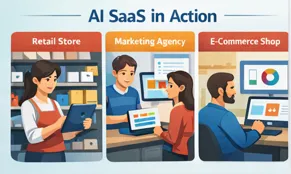
Understanding features and benefits is helpful, but seeing how AI-powered SaaS works in real-world situations makes the value much clearer. Small businesses across industries are already using AI tools to save time, reduce costs, and grow revenue. Below are relatable examples that show how these tools can be applied in everyday business scenarios.Local Retail Store Improves Inventory Forecasting
Imagine a small retail store that frequently struggles with overstocking slow-moving items while running out of popular products. Traditionally, inventory decisions might be based on guesswork or simple spreadsheets. However, by adopting AI-powered inventory management software, the store can analyze past sales patterns, seasonal trends, and customer buying behavior.
The AI system predicts which products are likely to sell quickly and recommends optimal reorder times. Instead of tying up cash in excess inventory, the store maintains balanced stock levels. This reduces waste, improves cash flow, and increases customer satisfaction because popular items remain available.
Over time, the store owner gains better visibility into purchasing trends and can negotiate smarter deals with suppliers. What once required hours of manual analysis becomes an automated, data-driven process.
Service-Based Business Automates Client Onboarding
Consider a small marketing agency that signs multiple new clients each month. Previously, onboarding required sending contracts manually, scheduling meetings, collecting intake forms, and following up repeatedly for missing information. The process was time-consuming and inconsistent.
By implementing AI-powered workflow automation software, the agency creates a structured onboarding sequence. When a new client signs, automated emails are triggered, documents are sent digitally, and meetings are scheduled automatically based on availability. AI chatbots answer common onboarding questions instantly.
This not only saves hours of administrative work but also provides clients with a smooth and professional experience. As a result, the agency improves efficiency while maintaining high service standards.
E-Commerce Store Boosts Sales with AI Recommendations
A small online shop selling apparel uses AI-driven recommendation tools to personalize customer experiences. Instead of displaying generic product suggestions, the AI analyzes browsing history, past purchases, and customer preferences.
When a visitor returns to the website, they see products tailored to their interests. Automated email campaigns also recommend complementary items based on prior purchases. This level of personalization increases average order value and repeat purchases.
By leveraging AI, the e-commerce store competes effectively with larger retailers, offering a personalized shopping experience without hiring a large analytics team.
Startup Reduces Support Costs with AI Chatbots
A small software startup receives frequent customer inquiries about setup instructions, pricing, and troubleshooting. Hiring a large support team isn’t financially feasible. Instead, the company integrates an AI-powered chatbot into its website.
The chatbot answers common questions instantly, routes complex issues to human agents, and collects customer details automatically. It operates 24/7, ensuring customers receive assistance even outside business hours.
As a result, support response times improve, customer satisfaction increases, and operational costs remain manageable. Human support agents can now focus on higher-level issues rather than repetitive questions.
These examples show that AI-powered SaaS is not limited to tech giants. Small retail shops, service providers, online stores, and startups can all benefit from intelligent automation and predictive insights. The key is identifying where AI can remove friction, reduce manual work, and enhance customer experience.
The Future of AI SaaS for Small Businesses
AI-powered SaaS is not just a passing trend it represents a long-term shift in how businesses operate. For small business owners, this evolution brings both opportunity and responsibility. As AI technology becomes more advanced and more accessible, businesses that adapt early will gain a strong competitive advantage. Understanding what’s coming next helps you prepare strategically rather than reactively.
Hyper-Personalization Will Become the Standard
Customers increasingly expect personalized experiences. In the near future, AI-powered SaaS tools will deliver even deeper levels of customization. Instead of basic segmentation, businesses will be able to tailor marketing messages, product recommendations, and service interactions in real time.
For example, AI systems may adjust website content dynamically based on a visitor’s browsing behavior, location, or purchase history. Email campaigns will become highly individualized, with messaging optimized automatically for each recipient. Small businesses that embrace personalization will build stronger customer loyalty and increase lifetime value.
What was once considered advanced enterprise technology will become standard practice for businesses of every size.
AI Agents and Digital Assistants
The next wave of AI SaaS will include more autonomous digital assistants. These AI agents won’t just analyze data they will take action based on business goals. For instance, an AI assistant could automatically adjust ad budgets to maximize ROI, negotiate vendor pricing recommendations, or manage customer follow-ups without constant supervision.
For small business owners, this means less time spent managing daily operations and more time focused on strategic growth. Rather than manually overseeing every system, you’ll guide AI tools with clear objectives and allow them to execute tasks intelligently.
This shift moves AI from being a helpful tool to becoming an active operational partner.
Predictive Business Intelligence for Everyone
Advanced predictive analytics will become easier to understand and use. Instead of complex dashboards filled with technical data, AI SaaS platforms will present insights in simple, conversational formats. Business owners might receive notifications like: “Based on current trends, increasing your inventory of Product A by 15% could improve revenue next month.”
This democratization of business intelligence allows small companies to make data-driven decisions without hiring analysts. Predictive forecasting for sales, cash flow, staffing, and customer retention will become a normal part of daily business management.
Better forecasting reduces risk and increases confidence in decision-making.
Voice and Conversational Interfaces
As voice recognition and natural language processing improve, small businesses will interact with SaaS platforms more naturally. Instead of navigating complex menus, owners may simply ask, “What were my top-performing products this week?” and receive immediate insights.
Voice-enabled tools and conversational dashboards will make advanced technology feel more intuitive and accessible. This reduces the learning curve and increases adoption among non-technical users.
Technology will continue becoming more human-centered rather than system-centered.
Greater Accessibility and Affordability
Perhaps the most important trend is continued accessibility. As competition grows among SaaS providers, pricing will remain competitive, and features once reserved for enterprise customers will continue moving downstream to small businesses.
Open integrations, user-friendly interfaces, and scalable subscription models will allow businesses to adopt AI gradually. The barrier to entry will keep decreasing, making innovation available to even the smallest startups.
Small businesses that stay informed and willing to experiment will thrive in this evolving landscape.
AI-powered SaaS is reshaping the business world by making advanced technology practical, affordable, and scalable. The future promises even smarter automation, deeper personalization, and easier access to predictive insights. For small business owners, the key is not to adopt every new tool but to remain adaptable and strategically open to innovation.
Final Thoughts: Getting Started with AI-Powered SaaS Today
Adopting AI-powered SaaS does not require a massive budget, a technical background, or a complete overhaul of your business operations. In fact, the most successful small businesses approach AI gradually and strategically. The goal is not to automate everything overnight, but to identify where intelligent tools can create the most meaningful impact.
Start small. Choose one area of your business that feels time-consuming or inefficient whether it’s marketing, customer support, accounting, or scheduling. Select a single AI-powered SaaS tool that directly addresses that challenge. Test it, measure results, and refine your approach before expanding into other areas. This controlled adoption reduces risk and increases long-term success.
It’s also important to maintain balance. AI can automate tasks, analyze data, and provide insights, but it cannot replace your vision, creativity, or understanding of your customers. The most effective strategy combines human judgment with machine intelligence. Use AI to handle repetitive work and uncover patterns, while you focus on leadership, relationships, and strategic decisions.
Consistency matters. Regularly review performance metrics to ensure your tools are delivering value. Track improvements in efficiency, revenue growth, customer satisfaction, or time savings. If a tool isn’t meeting expectations, adjust your setup or consider alternatives. AI works best when it evolves alongside your business goals.
Finally, remain curious and adaptable. The AI landscape will continue to change, bringing new features and opportunities. Small businesses that embrace continuous learning and stay open to innovation will be better positioned to compete not just with other small companies, but with larger organizations as well.
AI-powered SaaS is more than just software. It represents a shift toward smarter, data-driven, and more efficient business operations. By starting thoughtfully and focusing on measurable outcomes, small business owners can leverage AI as a powerful partner in sustainable growth.
FAQs
AI-powered SaaS is cloud-based software that uses artificial intelligence to automate tasks, analyze data, and provide smart recommendations. Instead of just storing information, the software learns from data and helps businesses make better decisions. Small businesses can use it to improve marketing, sales, customer support, and operations without hiring technical experts.
Is AI SaaS expensive for small businesses?
Not necessarily. Most AI SaaS tools operate on subscription models, meaning you pay monthly or annually. Many platforms offer free plans or affordable starter packages designed specifically for small businesses. The key is choosing tools that provide clear value and measurable return on investment.
Do I need technical skills to use AI-powered SaaS tools?
No. Most modern AI SaaS platforms are designed for non-technical users. They provide user-friendly dashboards, tutorials, and customer support. While basic training is helpful, you do not need coding or AI expertise to benefit from these tools.
Can AI replace employees in small businesses?
AI is designed to assist, not replace. It automates repetitive and time-consuming tasks, allowing employees to focus on creative, strategic, and relationship-based work. When used correctly, AI increases productivity rather than eliminating jobs.
How secure is AI-powered SaaS?
Reputable SaaS providers use encryption, secure cloud hosting, and regular security updates. However, small business owners should always review a provider’s security policies and ensure compliance with relevant regulations. Good data practices on your end are also essential.
What is the best AI SaaS tool for beginners?
The “best” tool depends on your business needs. For marketing, email automation tools with AI features are often a good starting point. For finance, AI-powered accounting software can deliver immediate value. The best approach is to start with the area causing the biggest challenge in your business.
How long does it take to see results from AI SaaS?
Some benefits, like time savings from automation, can be immediate. Other results, such as improved sales forecasting or customer retention, may take a few months of data collection and optimization. Consistent use and proper setup are key to success.