
Introduction: The Growing Pressure of AI Infrastructure on Earth
Artificial intelligence is no longer a niche research field it is industrial infrastructure. Every large language model, image generator, or advanced simulation system runs on massive clusters of GPUs housed in hyperscale data centers. These facilities are no longer measured in racks or server rooms but in megawatts and gigawatts. A single modern AI campus can consume as much electricity as a small city. Multiply that by dozens of facilities under construction, and the strain becomes obvious.
Energy grids are tightening. Water resources are being diverted to cooling systems. Rural land near substations is being converted into compute campuses. Utilities in some regions are delaying residential electrification projects because AI facilities are consuming available capacity. Against this backdrop, an ambitious idea has emerged: if Earth is struggling to host AI infrastructure, could we build data centers in space?
At first glance, the idea sounds futuristic almost cinematic. Space offers abundant solar energy, vast emptiness and no local communities to protest land use. But engineering does not operate on imagination; it operates on physics and economics. To understand whether orbital AI infrastructure is realistic, we need to examine power generation, thermal management, launch economics, networking, radiation exposure, and environmental trade-offs. Only then can we separate theoretical possibility from practical viability.
What Is a Space-Based AI Data Center?
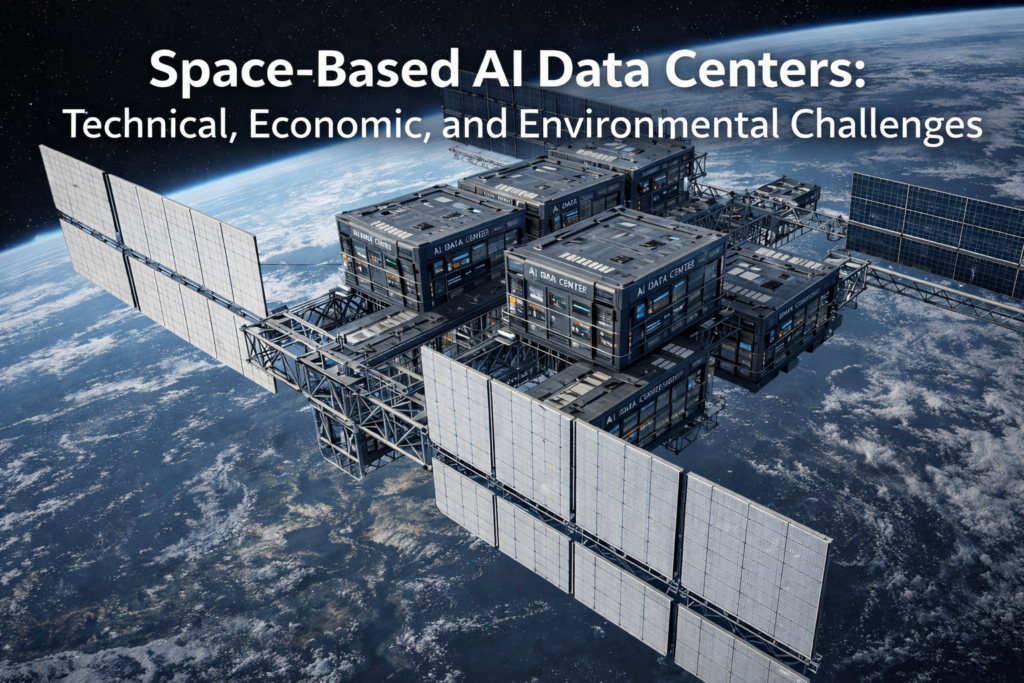
A space-based AI data center would not simply be a larger satellite. Traditional satellites perform limited onboard computing image compression, signal filtering, navigation control usually operating in kilowatt ranges. An orbital AI data center, by contrast, would function more like a hyperscale cloud facility placed in Low Earth Orbit (LEO). It would consist of high-performance compute modules (GPUs, TPUs, or custom AI accelerators), expansive solar arrays for energy generation, battery systems for eclipse periods, large thermal radiators for heat rejection, communication arrays for high-bandwidth transmission, and structural shielding against radiation and micrometeoroids.
Conceptually, it resembles a modular space station dedicated entirely to computation. Modules could be launched separately and assembled robotically in orbit, expanding capacity over time. Instead of warehouses filled with racks, you would have truss structures with solar wings extending outward and radiator panels spreading like metallic petals. The scale required for meaningful AI workloads, however, is far beyond what current satellites handle. Even a modest 10 MW orbital data center would dwarf most existing space structures in complexity and mass.
The key distinction is scale. Satellite edge computing is about processing data locally to reduce transmission needs. A true AI data center in orbit would attempt to handle large-scale training or inference workloads comparable to terrestrial cloud regions. That difference transforms the idea from incremental innovation into a radical infrastructure shift.
Why AI Data Centers Are Stressing Earth Infrastructure
To understand the appeal of space-based infrastructure, we must first appreciate how demanding AI has become on Earth. Modern AI training clusters can draw 100 to 500 megawatts per facility. Some proposed campuses are targeting gigawatt-scale deployments. For perspective, 100 megawatts can power roughly 80,000 homes. A single AI training complex can match the electricity demand of an entire mid-sized town.
Energy is only part of the equation. Cooling systems especially evaporative cooling consume millions of gallons of water annually. In drought-prone regions, this has sparked public controversy. Even closed-loop liquid cooling systems require significant infrastructure investment and maintenance. The combination of electricity demand and cooling requirements forces operators to locate facilities near robust transmission lines and water access, which narrows viable geographic options.
Land use is another constraint. Hyperscale facilities require hundreds of acres, high-voltage substations, fiber connectivity, and physical security perimeters. Suitable sites are becoming more competitive and expensive. Grid operators must build new transmission capacity to accommodate concentrated AI demand, sometimes at the expense of other development projects. AI workloads are continuous and predictable, creating base-load demand that reshapes regional energy planning.
Given these pressures, the logic of “moving the problem off-planet” begins to sound attractive. But solving terrestrial constraints by relocating infrastructure introduces a new class of challenges starting with power generation in orbit.
According to recent estimates on global data center power consumption, AI workloads are rapidly increasing grid pressure worldwide.
How Would Power Generation Work in Orbit?
Solar energy in space is undeniably appealing. In Low Earth Orbit, solar irradiance averages approximately 1,361 watts per square meter stronger and more consistent than most surface locations because there is no atmospheric absorption. High-efficiency space-grade solar panels can achieve conversion efficiencies exceeding 30 percent, yielding roughly 400 watts per square meter under optimal conditions.
However, orbital mechanics complicate the picture. Satellites in LEO orbit Earth approximately every 90 minutes. During each orbit, they experience periods of sunlight followed by eclipse as they pass behind the planet. Contrary to popular belief, most LEO systems do not receive uninterrupted 24/7 sunlight. This means energy storage is mandatory. If an AI facility requires 100 megawatts of continuous power and experiences 45 minutes of eclipse per orbit, it would need roughly 75 megawatt-hours of battery storage just to bridge that gap. Space-qualified batteries are expensive, heavy, and subject to degradation over time.
Scale further magnifies the challenge. To generate 100 megawatts at 400 watts per square meter, approximately 250,000 square meters of solar panels would be required roughly equivalent to 35 football fields. Those panels must be launched, deployed, and structurally supported in orbit. Efficiency losses occur during energy conversion, regulation, battery cycling, and power distribution, meaning real-world panel area would likely need to exceed theoretical minimums. While power generation in orbit is technically feasible, it demands enormous structural scale and mass, which directly impacts launch economics.
Cooling Challenges in Space: The Real Engineering Barrier
If power generation is challenging, thermal management is the true bottleneck. On Earth, servers dissipate heat through convection and conduction using airflows, liquid cooling loops, and heat exchangers. In space, there is no air. There is no medium for convection. Heat can only be removed through thermal radiation.
Radiative cooling follows the Stefan–Boltzmann law, which states that radiated power is proportional to surface area and the fourth power of temperature. In simple terms, to dissipate more heat, you either increase radiator area or operate at much higher temperatures. Operating AI chips at significantly elevated temperatures reduces performance and lifespan, so increasing surface area becomes the primary option.
To radiate 1 megawatt of heat at approximately 300 Kelvin (around 27°C), thousands of square meters of radiator surface are required. Scaling to 10 megawatts requires tens of thousands of square meters. At 100 megawatts, radiator area could exceed 300,000 square meters. These radiators must incorporate heat pipes, structural supports, and micrometeoroid shielding, all of which add mass. The geometric problem becomes severe because compute density scales with volume, while heat rejection scales with surface area creating an additional AI memory bottleneck in high-performance systems. As systems grow larger, the ratio of heat production to radiative surface becomes increasingly unfavorable.
This surface-versus-volume constraint represents one of the most fundamental scaling barriers for orbital data centers. You can stack GPUs densely in a terrestrial building and rely on efficient cooling loops. In space, every additional megawatt demands proportionally massive radiative expansion. Cooling is not merely a technical hurdle; it is a structural limitation dictated by physics.
Improving data center energy efficiency has become a national priority in several countries.
Launch and Construction Costs: The Brutal Economics of Orbit
Even if we assume power generation and radiative cooling can be engineered at scale, the economic gravity of launch costs pulls the concept back to Earth hard. Launch prices have decreased dramatically over the past decade thanks to reusable rockets, but they are still measured in thousands of dollars per kilogram. A realistic commercial range to Low Earth Orbit today sits around $2,000 per kilogram, with optimistic projections aiming lower in the future. Even if that number were cut in half, the economics would remain daunting.
Let’s run conservative numbers. A 1 MW terrestrial AI data center, including racks, switchgear, cooling systems, and structural support, can easily weigh over 100 metric tons. In orbit, additional mass is required for radiation shielding, reinforced structures, solar arrays, battery systems, and thermal radiators. Even with aggressive lightweight engineering, a 1 MW orbital system could realistically approach 200 metric tons, or 200,000 kilograms. At $2,000 per kilogram, launching that mass would cost roughly $400 million—for just one megawatt of compute capacity.
Now scale to something commercially meaningful. A 100 MW facility would require 20 million kilograms if mass scaled linearly, though in reality it could be even higher due to structural expansion. At current launch prices, that implies $40 billion in launch costs alone. Add the cost of compute hardware, space-rated components, robotic assembly missions, insurance, and redundancy systems, and total capital expenditure could approach or exceed $70–100 billion. By contrast, building a 100 MW terrestrial hyperscale facility typically costs between $1–3 billion. The economic gap is not incremental—it is structural and enormous.
Construction complexity compounds the problem. On Earth, cranes, trucks, and human technicians assemble data centers with relative ease. In orbit, construction would require autonomous robotics or astronaut-assisted assembly, both of which increase risk and cost. Every repair mission becomes a spaceflight operation. Routine hardware replacement transforms from a warehouse swap into an orbital logistics event. The convenience we take for granted on Earth disappears the moment hardware leaves the atmosphere.
Latency and Network Constraints: Physics Does Not Bend
Data centers are not isolated islands; they are nodes in a global network. AI training clusters require massive internal bandwidth and ultra-low latency communication between thousands of accelerators. Even small delays can reduce efficiency during distributed training, where synchronization timing matters.
Signals traveling between Earth and Low Earth Orbit experience round-trip latency typically between 5 and 20 milliseconds, depending on altitude and routing. While that may sound insignificant for casual internet browsing, hyperscale AI systems operate internally at microsecond-level latency. Adding even a few milliseconds can introduce synchronization inefficiencies during tightly coupled workloads.
Bandwidth is another limitation. Terrestrial data centers are connected by fiber networks capable of transmitting hundreds of terabits per second across continents. Satellite communication, even with advanced laser inter-satellite links, cannot yet match that sustained capacity. Ground stations provide limited connection windows depending on orbital paths, and global coverage requires complex relay networks.
The distinction between AI training and inference becomes critical here. Training requires extremely high internal bandwidth and frequent parameter synchronization across accelerators. Inference workloads, especially batch inference or delay-tolerant applications, are more forgiving. This suggests that if orbital AI infrastructure were ever deployed, it would likely focus on specialized or latency-tolerant workloads rather than acting as a primary training hub for frontier models.
In short, orbital AI systems would exist at the edge of terrestrial networks rather than at their core. Physics sets the speed limit, and no optimization strategy can exceed the speed of light.
Radiation and Hardware Durability: The Silent Degrader
Space is not just empty; it is saturated with high-energy radiation that can affect modern AI accelerators and increase the overall AI hardware carbon footprint over time. Solar flares, proton events, and galactic cosmic rays constantly bombard orbital hardware. While satellites are designed to tolerate this environment, AI accelerators are built using extremely small semiconductor nodes optimized for performance and energy efficiency not radiation resilience.
High-energy particles can cause single-event upsets, flipping bits in memory or registers. In high-performance AI clusters, even small error rates can corrupt calculations. Over time, cumulative radiation exposure degrades semiconductor materials, potentially shortening hardware lifespan. Radiation-hardened chips exist, but they typically lag behind cutting-edge commercial processors in performance and density. Choosing radiation-hardened components may significantly reduce computational efficiency per watt.
Shielding provides some protection, but shielding adds mass. Mass increases launch cost. The trade-off becomes unavoidable: more shielding improves durability but worsens economics. Less shielding reduces upfront cost but increases risk of failure and replacement missions. On Earth, replacing a faulty GPU is a routine maintenance task. In orbit, hardware replacement might require autonomous servicing spacecraft or crewed missions both expensive and complex.
Long-term reliability modeling would need to account for radiation-induced degradation over years of operation. Without frequent and affordable servicing capability, maintaining cutting-edge AI hardware in orbit becomes a logistical challenge that compounds over time.
Orbital Congestion and the Kessler Risk
Low Earth Orbit is becoming crowded. Thousands of active satellites already operate there, and mega-constellations continue to expand. Alongside functioning spacecraft, tens of thousands of debris fragments travel at velocities exceeding 7 kilometers per second. At those speeds, even a small fragment can destroy critical components on impact.
A large orbital AI data center would present a significant cross-sectional area due to its expansive solar arrays and radiator panels. This increases collision probability compared to compact satellites. Every square meter added for cooling or power generation also increases exposure to debris impact risk.
The concept of Kessler Syndrome describes a cascading chain reaction in which collisions create debris, which in turn causes further collisions. Introducing massive, large-surface-area infrastructure into already congested orbital bands could slightly elevate systemic risk. Insurance costs and regulatory scrutiny would likely rise accordingly. Unlike terrestrial disasters, orbital debris events can have long-lasting consequences because debris remains in orbit for years or decades depending on altitude.
Mitigation strategies such as debris tracking, shielding, and controlled deorbiting add further mass and complexity. Orbital infrastructure does not exist in isolation; it interacts with a dynamic and increasingly congested environment.
Economic Viability: Earth vs Space Reality Check
When all variables are placed side by side, the comparison becomes stark. On Earth, cooling leverages convection and liquid systems that are highly efficient. In space, only radiative cooling is available, demanding enormous surface area. Earth-based facilities require no launch cost, offer straightforward maintenance access, and connect directly to high-capacity fiber networks. Space-based facilities eliminate land constraints and potentially tap abundant solar energy but introduce astronomical launch costs, maintenance challenges, radiation exposure, and networking limitations.
Even if renewable energy integration continues to expand on Earth, terrestrial facilities can increasingly operate on solar, wind, hydro, or nuclear power. Grid decarbonization reduces the environmental argument for orbital relocation. Meanwhile, the economic delta between a few billion dollars on Earth and tens of billions in orbit remains difficult to justify in purely commercial terms.
The conclusion from an economic standpoint is clear: under present technological and cost structures, orbital AI data centers are not competitive with terrestrial alternatives for hyperscale workloads.
Environmental and Strategic Considerations
From an environmental perspective, shifting AI infrastructure to space does not eliminate ecological impact; it redistributes it. Rocket launches emit carbon dioxide and black carbon into upper atmospheric layers, where climatic effects can be amplified. Manufacturing large quantities of space-rated hardware carries its own resource footprint. Decommissioning orbital infrastructure requires controlled deorbiting to avoid debris hazards.
However, niche strategic applications could alter the equation. Military or sovereign infrastructure planners might value independence from terrestrial grids and geographic vulnerability. An orbital AI system powered by solar arrays could, in theory, operate independently of regional energy disruptions. Deep-space missions might benefit from nearby high-performance computing nodes capable of processing scientific data without constant Earth communication.
These are specialized scenarios, not commercial cloud replacements. The broader economic calculus for mainstream AI infrastructure remains unfavorable.
Final Verdict: Theoretical Possibility, Practical Improbability
Can AI data centers be built in space? Yes, in principle. Physics does not prohibit the concept. Solar energy is abundant in orbit. Radiative cooling, though inefficient, is possible. Modular construction techniques could assemble large structures over time. With enough capital and engineering effort, an orbital AI facility could exist.
But practicality is defined not just by possibility but by efficiency and return on investment. Today, Earth provides cheaper construction, easier maintenance, superior networking, and scalable energy integration. Space introduces massive launch costs, cooling constraints dictated by physics, radiation-induced reliability concerns, and congestion risks.
The idea of orbital AI infrastructure is intellectually fascinating. It pushes us to confront the physical realities of computation at scale. Yet when the numbers are calculated carefully and without romanticism, terrestrial data centers remain overwhelmingly more practical for hyperscale AI.
Space-based AI data centers may eventually emerge in limited, strategic, or scientific contexts. For now, however, they remain closer to a thought experiment than an industrial roadmap.
FAQs
Is building an AI data center in space technically possible today?
Technically, yes. With sufficient funding and engineering effort, a small-scale orbital AI facility could be constructed. However, scaling it to hyperscale levels comparable to terrestrial data centers would be economically prohibitive under current launch and technology constraints.
Would space-based solar power make AI greener?
Space offers strong solar irradiance, but battery storage, manufacturing emissions, and rocket launches introduce environmental costs. The net environmental benefit is uncertain and depends on advances in launch sustainability and grid decarbonization on Earth.
Why is cooling the biggest obstacle in space?
Because space lacks air or liquid for convection and conduction. Heat must be radiated away as infrared energy, which requires extremely large surface areas and adds substantial mass to the system.
Could orbital AI reduce grid strain on Earth?
In theory, yes. In practice, the enormous cost and engineering complexity make it far more efficient to expand renewable energy and grid infrastructure on Earth rather than relocate compute capacity to orbit.
Are there any realistic use cases for AI in space?
Yes. Niche applications such as on-orbit data processing, deep-space mission support, or highly secure sovereign systems could justify smaller-scale orbital AI deployments, though not full hyperscale replacements.
Conclusion
The rapid expansion of AI has forced the world to rethink infrastructure at a planetary scale. Energy demand, water consumption, and land use are no longer abstract concerns they are operational constraints shaping where and how computation happens. The temptation to relocate AI data centers to space stems from a desire to escape these pressures. Space appears vast, sunlit, and unconstrained.
But engineering reality is unforgiving. Radiative cooling scales poorly. Launch costs dominate capital expenditure. Radiation threatens hardware longevity. Networking constraints limit seamless integration with terrestrial systems. Each challenge compounds the next, forming a web of trade-offs that currently outweigh the benefits.
The future may bring ultra-cheap launch systems, revolutionary materials, advanced autonomous robotics, and radiation-tolerant high-performance chips.
If multiple breakthroughs converge, the economics could shift. Until then, Earth remains the most efficient platform for large-scale AI infrastructure. Space, for now, is an intriguing frontier not the next hyperscale cloud region.