
Introduction
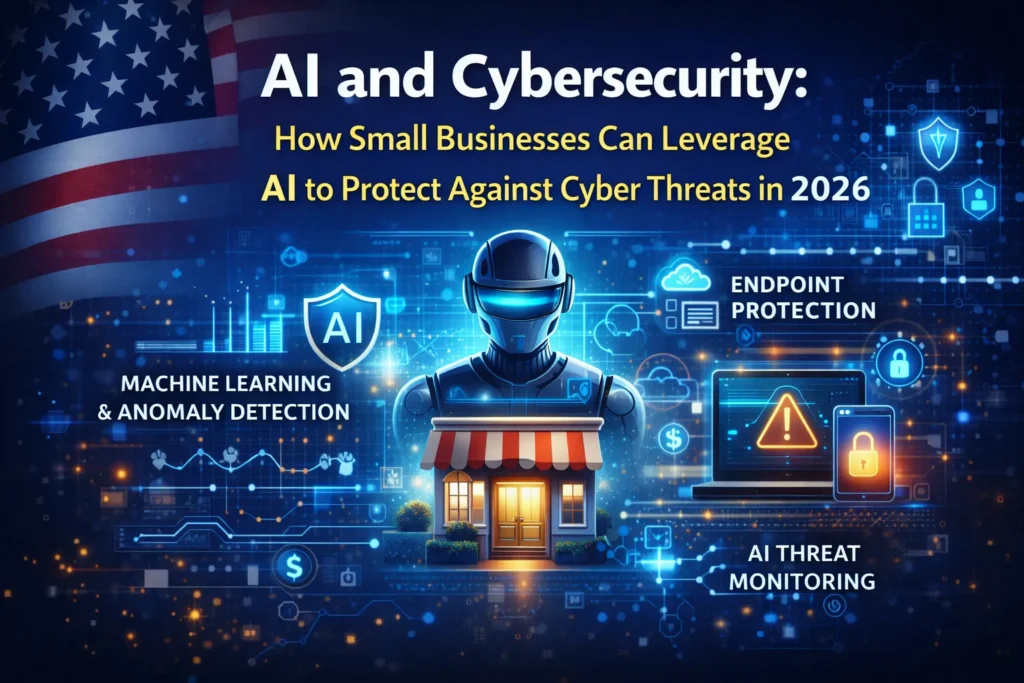
In 2026, cybersecurity has become a critical priority for small businesses across the USA. The reality is stark: cybercriminals are no longer targeting only large enterprises. Small and medium-sized businesses (SMBs) are increasingly attractive because they often lack advanced security infrastructures. This makes AI cybersecurity small business USA solutions not just a luxury, but a necessity for survival.
Artificial intelligence (AI) is transforming the way SMBs defend against cyber threats. Unlike traditional security systems, AI-driven security solutions can process massive amounts of data in real time, detect anomalies that humans might miss, and respond faster than any IT team could. From predictive security to automated monitoring, AI offers a proactive approach that shifts SMBs from reactive defense to strategic cyber resilience.
One of the key advantages of AI in cybersecurity is speed. AI tools can scan thousands of endpoints, emails, and network logs simultaneously, identifying suspicious activity before it escalates. Predictive threat detection is another game-changer: AI algorithms use machine learning to analyze historical patterns, identifying the early signs of ransomware attacks, phishing attempts, or insider threats. This is particularly valuable for small businesses, which often operate with limited IT staff and resources.
Another major benefit is automated monitoring. Instead of relying on manual reviews or scheduled scans, AI continuously monitors networks and endpoints, flagging potential breaches in real time. For example, an AI-driven phishing detection tool can instantly quarantine a suspicious email, preventing an employee from accidentally triggering a ransomware infection. Similarly, endpoint AI protection can isolate compromised devices, minimizing downtime and potential data loss.
For SMB owners and IT managers, adopting AI does not mean replacing human oversight. Instead, it means enhancing capabilities, allowing teams to focus on strategic initiatives rather than firefighting daily threats. This article will provide practical guidance, from understanding how AI detects cyber threats to actionable steps SMBs can implement immediately. By the end, you’ll have a clear roadmap for leveraging AI cybersecurity tools 2026 to protect your business from evolving digital threats.
In 2026, having a strong cybersecurity framework is no longer optional for small businesses operating in the U.S. Many of the foundational principles of small business cybersecurity in the USA such as layered defense, endpoint protection, and access control must be in place before AI-driven security solutions can deliver maximum impact.
Whether your business is a small tech startup in San Francisco or a family-owned store in Dallas, AI can level the cybersecurity playing field, offering protection that once only enterprise-level organizations could afford. Let’s dive into how AI detects threats, the tools available, and the strategies that small businesses can adopt today to stay ahead of cybercriminals.
How AI Detects Cyber Threats
In 2026, AI cybersecurity for small business USA is not just about installing software it’s about leveraging intelligent systems that actively analyze, predict, and respond to threats. Understanding how AI detects cyber threats is the foundation of an effective SMB security strategy. Unlike traditional defenses, AI doesn’t just react it learns from data, identifies patterns, and detects anomalies that could indicate malicious activity. This capability makes AI-driven security solutions essential for small businesses, which often lack large IT departments.
AI systems rely heavily on machine learning and anomaly detection to spot unusual behaviors across networks, endpoints, and cloud services. These systems continuously learn from normal operations, creating a “baseline” of acceptable activity. When a deviation occurs—like a sudden spike in data downloads from an employee’s workstation or a login from an unusual geographic location—AI flags it for further inspection. This allows SMBs to identify threats before they escalate, significantly reducing potential damage.
Machine Learning & Anomaly Detection
Machine learning (ML) is at the core of AI cybersecurity tools 2026. In practical terms, ML algorithms can analyze massive datasets from emails, servers, endpoints, and network traffic, identifying patterns that humans may overlook. For instance, a small retail business might notice occasional failed login attempts, but an AI system can detect a subtle pattern across multiple accounts, signaling a potential brute-force attack.
Real-world SMB example: Imagine a local accounting firm in Chicago. Employees regularly access client data during business hours. AI-driven monitoring notices that a user account is suddenly attempting multiple off-hours file downloads. The system immediately triggers an alert, isolates the account, and provides a detailed report. Without AI, this subtle but potentially catastrophic breach could have gone unnoticed until data was exfiltrated.
Anomaly detection is particularly effective against zero-day attacks threats without known signatures. Traditional antivirus systems rely on predefined rules, leaving SMBs vulnerable to novel malware. AI, by contrast, evaluates behavioral deviations rather than relying solely on known threat databases. Over time, this creates a more adaptive, predictive security posture, which is exactly what SMBs need to stay ahead of modern cybercriminals.
AI in Phishing & Ransomware Prevention
Phishing and ransomware remain two of the most significant threats to small businesses. According to recent reports, over 50% of SMB breaches in the U.S. originate from phishing emails or ransomware attacks. AI addresses these challenges by automating detection and response.
AI-driven email scanning systems analyze incoming messages for suspicious patterns, including unusual sender behavior, malicious links, or atypical attachment types. Advanced systems assign threat scores to each email, automatically quarantining messages that exceed risk thresholds. If an employee accidentally clicks a malicious link, AI incident response tools can isolate affected devices, roll back compromised files, and alert IT teams all in real time.
Example in action: A small marketing agency receives a seemingly legitimate invoice via email. The AI system detects inconsistencies in the sender’s domain and unusual phrasing, assigns a high threat score, and moves the email to quarantine before anyone opens it. This automated defense prevents ransomware from infiltrating the network, reducing potential downtime and financial loss.
By combining machine learning, anomaly detection, and automated phishing prevention, small businesses can significantly enhance their cybersecurity posture. AI doesn’t just detect known threats it predicts, prevents, and provides actionable insights to stop attacks before they occur, making it an indispensable ally for SMBs in the U.S. in 2026.
AI-powered phishing detection has become essential as the volume and sophistication of cyber threats targeting small businesses continues to rise, particularly in areas like credential theft, ransomware deployment, and business email compromise.
AI-Driven Security Solutions for SMBs
For small businesses in the USA, deploying AI-driven security solutions is no longer optional it’s a necessity in 2026. Cyber threats are evolving faster than ever, and small IT teams often lack the bandwidth to manually monitor every endpoint, email, and cloud system. AI cybersecurity tools 2026 allow SMBs to automate threat detection, analyze complex data, and respond proactively, leveling the playing field with larger enterprises.
AI-driven solutions come in multiple forms, from endpoint protection to network and cloud security platforms. These tools are designed to work seamlessly with SMB environments, requiring minimal configuration while providing advanced predictive security. By integrating these systems, small businesses can achieve continuous monitoring, automated incident response, and real-time threat intelligence. Let’s dive deeper into the two core categories: endpoint AI protection and network/cloud AI security tools.
Endpoint AI Protection
Endpoints computers, mobile devices, POS systems, and IoT devices are often the weakest links in SMB cybersecurity. A single compromised device can provide a gateway for ransomware, phishing attacks, or data exfiltration. Endpoint AI protection uses machine learning and behavioral analysis to detect suspicious activity at the device level, often before human operators even notice.
Automated Malware Detection
Traditional antivirus relies on signature databases, which can’t keep up with new, evolving threats. AI cybersecurity tools use behavior-based detection instead. For example, if a laptop suddenly starts encrypting multiple files or connecting to unusual IP addresses, the AI system flags it immediately. This proactive approach helps SMBs prevent malware from spreading, saving both data and time.
Behavior Analysis
Beyond malware, AI monitors device behavior to detect subtle anomalies. Unusual login patterns, unexpected software installations, or abnormal network traffic can all indicate a breach. For instance, an AI system might detect that an employee’s device is sending encrypted data to a foreign server at 2 a.m. a classic ransomware exfiltration attempt.
Remote Threat Mitigation
One of the greatest advantages for SMBs is the ability to remotely isolate compromised endpoints. AI platforms can automatically quarantine devices, restrict network access, and even roll back suspicious changes without waiting for IT intervention. This reduces downtime, prevents further spread, and ensures business continuity.
Real-World SMB Example: A small e-commerce business in New York experienced multiple phishing attempts targeting employee emails. Their AI-driven endpoint solution detected malware in an attachment before any files were opened, automatically quarantined the device, and notified the admin team. This seamless intervention prevented a potential data breach, demonstrating the practical value of endpoint AI protection.
Network & Cloud Security AI Tools
While endpoints are critical, SMBs increasingly rely on cloud infrastructure and internal networks to store sensitive data. AI cybersecurity tools 2026 offer predictive monitoring, intrusion detection, and automated alerts to safeguard these environments.
Predictive Monitoring
AI systems continuously monitor network traffic, cloud storage access, and application behavior. Machine learning models predict potential threats by comparing current activity against historical patterns. This enables preemptive action stopping attacks before they can damage systems or steal data. For example, if unusual file transfer patterns emerge in a cloud storage account, AI can alert admins or temporarily restrict access.
Intrusion Detection
AI-driven intrusion detection systems (IDS) identify suspicious access attempts, brute-force login attacks, and lateral movement within networks. Unlike traditional IDS, AI tools learn and adapt over time, reducing false positives and improving the accuracy of threat alerts. Small businesses can therefore focus their limited IT resources on genuine threats instead of chasing harmless anomalies.
Alert Systems
Modern AI solutions provide real-time notifications, detailed threat analysis, and suggested remediation steps. Alerts can be delivered via dashboards, email, or mobile apps, ensuring that SMB owners and IT managers remain aware of risks even when working remotely. Integration with incident response workflows means that AI doesn’t just detect threats it helps manage them efficiently, minimizing potential business impact.
By combining endpoint AI protection with network and cloud security AI tools, small businesses gain a multi-layered defense. AI cybersecurity tools 2026 make it possible for SMBs to maintain enterprise-grade security without hiring large IT teams, offering predictive threat detection, automated response, and continuous monitoring all critical in today’s rapidly evolving threat landscape.
Implementing AI Cybersecurity in Small Businesses
Adopting AI cybersecurity tools for small business USA doesn’t have to be overwhelming or expensive. While the technology may sound complex, there are practical strategies and cost-effective solutions that allow SMBs to implement AI-driven protection without straining budgets. The key is to combine right-sized tools, strategic planning, and employee engagement to create a resilient security posture.
Many SMBs hesitate to adopt AI because of perceived high costs or lack of technical expertise. However, modern AI cybersecurity tools are increasingly designed for small business environments, with SaaS models, user-friendly dashboards, and cloud-based management. These solutions provide enterprise-level capabilities, including predictive security, anomaly detection, and automated monitoring, but at a fraction of the cost.
Beyond technology, employee training is a critical aspect of AI implementation. AI can detect anomalies and threats, but employees are still the first line of defense. Awareness programs, phishing simulations, and AI-assisted education help teams recognize suspicious activity, report potential threats, and work effectively with AI-driven security systems.
Cost-Effective AI Tools
Small businesses can leverage affordable, SMB-friendly AI solutions without compromising security. Many vendors now offer free tiers, trial versions, or subscription-based models suitable for small teams. For instance:
- SaaS Platforms: Cloud-based AI solutions eliminate the need for on-premise infrastructure and allow small teams to deploy advanced security tools with minimal IT overhead.
- Free or Trial Versions: Many AI cybersecurity platforms offer limited free plans or 30-day trials, enabling SMBs to test features like automated malware detection, phishing prevention, and predictive monitoring before committing financially.
- Scalable Options: AI tools can scale as the business grows, starting with core features like endpoint protection and email scanning, then expanding to cloud security and intrusion detection.
Example: A small accounting firm might start with a cloud-based AI email scanning tool to protect against phishing, then add endpoint AI protection and cloud monitoring as the company grows, ensuring cost-effectiveness while maintaining robust security.
Employee Training & AI Awareness
Even the most advanced AI cybersecurity system can be undermined by untrained employees. SMBs must integrate AI awareness into daily security practices. This includes:
- Phishing Simulations: AI can generate realistic phishing emails to test employees, providing feedback on mistakes and improving detection skills.
- Security Workshops: Regular workshops help staff understand AI alerts, threat scoring, and safe behavior online.
- Collaboration with AI Tools: Train employees to recognize AI notifications and take appropriate actions, such as reporting suspicious emails, following quarantine recommendations, or verifying unusual system activity.
Example in Action: A small e-commerce company in Texas implemented AI-driven phishing simulations. Employees initially clicked on 20% of simulated phishing emails. After three months of training combined with AI alerts, the click rate dropped to 2%, demonstrating how AI tools and human awareness together create a stronger defense.
By combining cost-effective AI tools with structured employee training, small businesses can build a layered, proactive cybersecurity strategy. This ensures that AI doesn’t operate in isolation, but as a complementary force enhancing human vigilance, predictive threat detection, and automated monitoring across all systems.
Actionable AI Cybersecurity Checklist
Implementing AI cybersecurity for small business USA can feel daunting, but breaking it into practical, actionable steps makes the process manageable. The following checklist provides SMB owners and IT managers with clear, real-world strategies to leverage AI-driven security solutions effectively in 2026.
Key Steps for SMBs
1. Conduct an AI Security Assessment
Start by evaluating your current cybersecurity posture. Identify gaps in endpoint protection, email security, network monitoring, and cloud usage. AI threat detection SMB tools can help scan your systems to highlight vulnerabilities before implementing new solutions.
2. Implement Endpoint AI Protection
Deploy AI-driven antivirus and behavior analysis on all devices. This ensures malware, ransomware, and anomalous activity are detected automatically. For instance, AI can isolate a compromised workstation before it spreads threats across the network.
3. Enable Automated Email Scanning
Use AI-powered email security tools to identify phishing attempts. Set threat scoring rules so suspicious emails are automatically quarantined, reducing risk of human error.
4. Monitor Network Traffic with AI
Implement AI-driven network monitoring to detect unusual traffic patterns, suspicious logins, and potential intrusions. Continuous monitoring helps SMBs respond to threats proactively.
5. Secure Cloud Services with AI
Leverage AI cybersecurity tools to oversee cloud storage and applications. Predictive monitoring alerts you to unusual access, file downloads, or configuration changes in real time.
6. Schedule Regular AI-Driven Vulnerability Scans
Use AI tools to scan systems periodically for weaknesses, outdated software, and insecure configurations. Automated scans reduce the manual workload and improve overall security posture.
7. Conduct Phishing Simulations
Test employees using AI-generated phishing emails. Track response rates, provide training, and repeat simulations until the team demonstrates strong awareness.
8. Apply Predictive Security Measures
Use AI to predict potential threats based on historical and behavioral data. For example, if AI identifies unusual login patterns, preemptively require multi-factor authentication for affected accounts.
9. Configure Automated Alerts
Set up real-time AI alerts for suspicious activity, unauthorized access, and malware detection. Ensure alerts are actionable and reach the right personnel immediately.
10. Maintain an Incident Response Plan
Combine AI detection with a structured response protocol. Define steps to isolate endpoints, restore data, and notify stakeholders if AI flags a serious incident.
11. Integrate AI into Existing Security Tools
Ensure new AI solutions complement your firewall, VPN, and password management tools. Integration improves visibility and strengthens predictive security across all layers.
12. Educate Employees on AI Alerts
Teach staff to recognize AI-generated notifications and understand recommended actions. This ensures human oversight works hand-in-hand with automated monitoring.
13. Update AI Models Regularly
Ensure AI algorithms are updated to reflect emerging threats. Vendors often provide patches or updated threat libraries to maintain high detection accuracy.
14. Review AI Performance Metrics
Periodically evaluate AI tool effectiveness using dashboards, incident reports, and threat detection rates. Adjust configurations to reduce false positives while maximizing real threat coverage.
15. Plan for Scalability
Select AI cybersecurity tools that grow with your business. Start with core features and expand to endpoint, network, and cloud protection as your SMB scales.
By following this checklist, small businesses can create a comprehensive, layered defense. Combining AI detection, automated monitoring, and employee awareness ensures SMBs are not only protected from current cyber threats but are prepared for emerging risks in 2026.
Challenges & Limitations of AI in SMB Security
While AI cybersecurity tools offer tremendous advantages for small businesses, they are not a magic bullet. Understanding the challenges and limitations is essential for SMBs to deploy AI effectively without over-reliance or unexpected costs. In 2026, small businesses must balance the benefits of AI with practical considerations like implementation complexity, ongoing maintenance, and human oversight.
Costs & Implementation
One of the most significant challenges for SMBs adopting AI cybersecurity is cost management. Advanced AI-driven security platforms often come with subscription fees, hardware requirements, or cloud storage costs. While these solutions are cheaper than building a full-scale IT security team, SMB owners must carefully evaluate ROI vs. risk exposure.
Implementation can also be complex. AI tools require initial setup, integration with existing infrastructure, and proper configuration to function optimally. For instance, endpoint AI protection must be installed on every device, while network AI tools need access to traffic logs and server data. Small businesses without dedicated IT staff may struggle during the deployment phase.
Practical Considerations:
- Start small with critical systems and gradually expand coverage.
- Choose SaaS platforms that require minimal on-premise hardware.
- Leverage vendor support or consultants to configure AI correctly.
Scalability is another factor. A solution that works for ten devices may not scale efficiently as the business grows. SMBs should select tools designed to grow with their operations, avoiding costly replacements or complex migrations in the future.
False Positives & Human Oversight
AI cybersecurity tools are highly effective but not infallible. False positives, where benign activity is flagged as malicious, can create unnecessary alerts and disrupt business operations. For small businesses with limited IT staff, this can lead to alert fatigue and slow response times.
Human oversight remains critical. AI can detect patterns and anomalies, but it cannot fully replace human judgment. For example, AI may flag a large file transfer as suspicious, but a human analyst can determine it is part of normal business operations. By combining AI with manual review, SMBs ensure accurate responses while maintaining efficiency.
Best Practices for Oversight:
- Establish a clear workflow for reviewing AI alerts.
- Train staff to interpret AI findings and take appropriate actions.
- Periodically audit AI performance to reduce false positives and adjust thresholds.
Another limitation is adaptation to evolving threats. Cybercriminals continuously change tactics to bypass AI detection. While AI learns from historical data, human input is required to fine-tune models, update threat intelligence, and respond to new attack vectors.
In summary, while AI cybersecurity tools provide powerful protections for small businesses, they require investment, proper implementation, and human collaboration. Understanding these challenges ensures SMBs deploy AI effectively, maximizing security benefits while avoiding pitfalls like alert fatigue, high costs, or incomplete coverage.
Conclusion
AI is no longer a futuristic concept for cybersecurity it’s a practical, accessible tool that small businesses in the USA can leverage today to defend against cyber threats in 2026. From predictive threat detection to automated monitoring, AI cybersecurity small business USA solutions enable SMBs to stay one step ahead of cybercriminals, even with limited IT resources.
Throughout this article, we’ve explored how AI detects threats using machine learning, anomaly detection, and predictive security, providing real-world examples of phishing and ransomware prevention. We discussed AI-driven security solutions, including endpoint protection, network monitoring, and cloud security tools, all designed to protect SMB environments efficiently. Implementing AI doesn’t mean replacing human oversight it means augmenting staff capabilities, freeing employees to focus on strategic initiatives while AI handles routine monitoring and threat detection.
Practical adoption requires a combination of cost-effective AI tools, employee training, and a structured approach guided by actionable steps. The 12–15 point checklist outlined earlier provides a clear roadmap for SMBs to follow from endpoint protection and phishing simulations to automated alerts and vulnerability scans. By combining AI technology with human vigilance, SMBs can build a layered defense system capable of adapting to evolving threats.
At the same time, SMBs must recognize the challenges of AI adoption, including costs, integration complexity, false positives, and the need for human oversight. Awareness of these limitations ensures that AI tools are deployed strategically, with realistic expectations and proper governance.
The bottom line is clear: AI is no longer optional in small business cybersecurity it is an essential component of a proactive, resilient defense strategy. SMB owners and IT managers who embrace AI-driven security solutions in 2026 will be better positioned to protect sensitive data, maintain business continuity, and build customer trust.
By adopting AI strategically and fostering a culture of cybersecurity awareness, small businesses can transform cyber defense from a reactive necessity into a competitive advantage. AI doesn’t just prevent breaches it empowers SMBs to operate confidently in a rapidly evolving digital landscape.
FAQs
How can a small business use AI to prevent phishing attacks?
AI-driven email scanning tools automatically detect and quarantine suspicious emails. Coupled with threat scoring and phishing simulations, AI keeps employees alert and reduces the risk of breaches caused by human error.
Are AI tools affordable and scalable for small businesses?
Yes. Many SaaS-based AI cybersecurity tools offer subscription plans, free tiers, or trial versions, allowing SMBs to start within their budget and scale features as the business grows.
How does AI protect endpoints in a small business?
Endpoint AI protection detects malware and ransomware, monitors suspicious behavior, and remotely isolates compromised devices, preventing downtime and data loss.
What is the biggest challenge for small business owners adopting AI?
The main challenges are cost, implementation complexity, and false positives. Deploying AI tools with proper configuration and human oversight makes these challenges manageable.
How should employees be involved in AI cybersecurity?
Employees should be trained to understand and respond to AI alerts. Regular phishing simulations and security awareness programs ensure AI and human vigilance work together, providing stronger protection for SMBs.