
Introduction: The Rumors Linking Meta and Prada
The idea of Prada AI glasses might have sounded unrealistic a year ago. Today, it feels plausible.
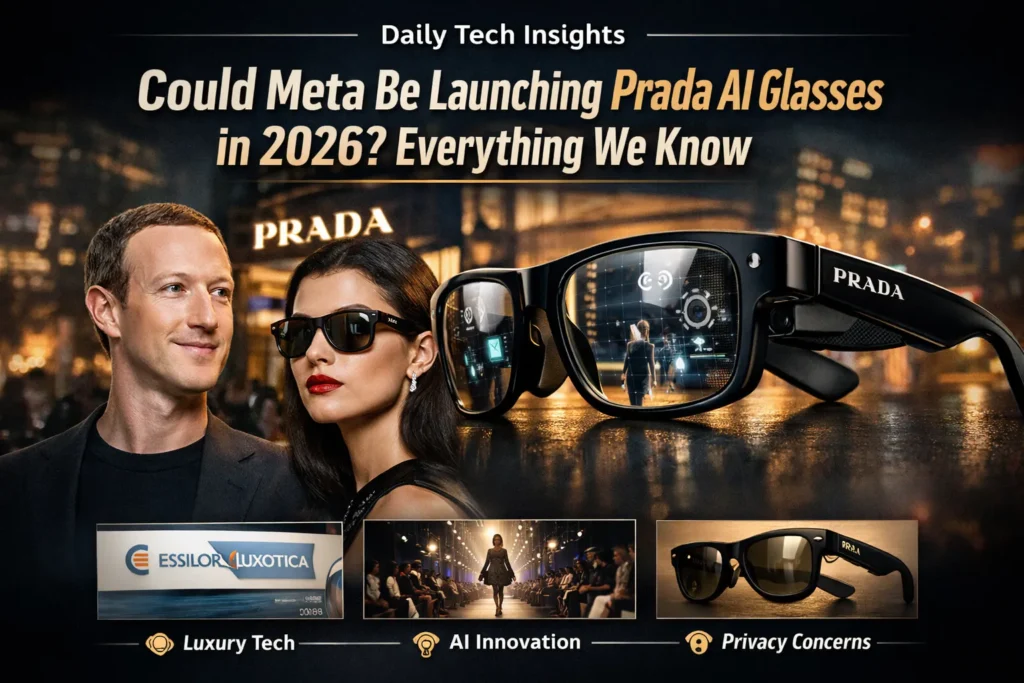
Speculation intensified after Mark Zuckerberg and Priscilla Chan were spotted at Prada Fashion Week 2026, sparking conversations about a possible luxury collaboration between Meta and the Italian fashion powerhouse. While there is no official confirmation from Meta, the timing of events, licensing agreements, and Meta’s expanding smart glasses portfolio have fueled industry discussions.
Meta has already proven that AI-powered eyewear can succeed commercially. The Ray-Ban Meta glasses reportedly sold over 7 million units in 2025, demonstrating strong mainstream adoption. The Oakley Meta line further expanded into the athletic and performance market. So the logical next step? Enter the luxury segment.
A Prada edition would not just be another product launch. It would represent a strategic move into high-fashion territory, blending advanced AI capabilities with premium design aesthetics. In a market where tech devices increasingly double as lifestyle statements, such a partnership could redefine smart glasses positioning.
This article explores what we know, what we can reasonably speculate, how this would impact Meta’s strategy, and whether privacy concerns could overshadow luxury appeal.
The Current Meta AI Glasses Lineup
Before analyzing the Prada rumors, it’s important to understand Meta’s current smart glasses ecosystem.
Ray-Ban Meta: The Mainstream Success Story
The Ray-Ban Meta collaboration marked Meta’s first real commercial breakthrough in wearable AI. By pairing familiar, stylish frames with built-in AI features, Meta avoided the common mistake of making tech devices look too futuristic or bulky.
The Ray-Ban Meta glasses offer:
- Built-in camera and voice assistant
- Live streaming capabilities
- AI-powered contextual assistance
- Lightweight design for everyday wear
Selling approximately 7 million units in 2025 positioned Meta as a serious player in the wearable AI space. The collaboration succeeded because it combined recognizable design heritage with modern functionality.
Oakley Meta: Targeting the Athletic Market
Oakley Meta glasses took a more niche approach. Built for sports enthusiasts and active users, they emphasize durability, performance tracking, and enhanced visual overlays.
Unlike Ray-Ban’s lifestyle focus, Oakley targets athletes and performance-driven consumers. This segmentation strategy shows that Meta understands brand identity matters just as much as hardware.
If Ray-Ban is mainstream and Oakley is athletic, Prada could represent something entirely different: luxury prestige.
Prada AI Glasses Rumors: What’s Fueling the Speculation?
The rumors surrounding Meta AI glasses Prada edition are not random internet fantasies. Several real-world developments make the speculation credible.
First, EssilorLuxottica, the eyewear manufacturing giant behind Ray-Ban and Oakley Meta glasses, also holds Prada’s eyewear licensing agreement. That agreement was renewed until 2030, with an option extending to 2035. Since EssilorLuxottica already manufactures Meta’s smart glasses, expanding into a Prada edition would be logistically feasible.
Second, Zuckerberg’s presence at Prada Fashion Week 2026 was highly visible. While attending fashion events does not confirm a partnership, it strengthens the narrative that Meta may be exploring luxury collaborations.
Third, the broader market trend supports the idea. Tech companies increasingly collaborate with luxury brands. Apple’s partnership with Hermès for high-end Apple Watch editions is a clear example of how fashion collaborations elevate device perception.
While Meta has not confirmed any Prada AI glasses project, the alignment of manufacturing partnerships, market positioning opportunities, and fashion industry signals makes the speculation grounded rather than far-fetched.
Why a Prada Collaboration Could Change the Smart Glasses Market
Entering the luxury segment would shift Meta’s brand positioning.
Currently, Meta smart glasses are perceived as functional lifestyle devices. A Prada edition could elevate them into fashion statements. Luxury consumers often value exclusivity and craftsmanship. If Meta integrates premium materials, limited-edition designs, and tailored aesthetics, the product could command significantly higher margins.
Luxury smart glasses would also appeal to a different demographic. Instead of targeting tech enthusiasts or social media users, Meta could reach fashion-forward consumers who prioritize design first and technology second.
This shift matters because wearable devices succeed when they feel natural. Glasses are not just gadgets; they are visible accessories. A luxury design makes them socially acceptable in high-end settings.
Moreover, entering luxury tech aligns with broader trends in premium AI products. As AI becomes more integrated into daily life, brands that blend utility with status symbolism may dominate.
A Prada collaboration could position Meta as a lifestyle brand rather than purely a tech platform.
Meta AI Glasses vs Ray-Ban vs Oakley vs Prada (Speculative Comparison)
| Feature | Ray-Ban Meta | Oakley Meta | Prada AI Glasses (Rumored) |
|---|---|---|---|
| Market Position | Mainstream lifestyle | Athletic performance | Luxury / High Fashion |
| Estimated Price Range | Mid-tier | Mid to high | Premium / Luxury pricing |
| Target Audience | Everyday consumers | Athletes & fitness users | Fashion-forward luxury buyers |
| Design Focus | Classic style | Sport durability | Premium craftsmanship |
| AI Capabilities | Voice + Camera AI | Performance-focused AI | Likely similar AI stack |
This table highlights how Prada AI glasses could fill a new segment rather than compete directly with existing models.
Privacy Concerns: The Biggest Obstacle
Despite the excitement, privacy concerns remain a major barrier.
Smart glasses with built-in cameras raise surveillance concerns. Facial recognition technology, even if limited, triggers public discomfort. Some users already express skepticism about always-on AI devices in public spaces.
Key concerns include:
- Unauthorized facial recognition
- Data collection transparency
- Social discomfort in public environments
Luxury positioning might amplify scrutiny. High-profile collaborations attract media attention, which could intensify debates about ethical AI usage.
For Meta to succeed in the luxury space, privacy safeguards must be clear, transparent, and easy to control. Visible recording indicators, user-controlled data permissions, and compliance with global data regulations will be essential.
Without strong privacy assurance, even the most stylish AI glasses could face backlash.
Expert Predictions: Will Meta Launch Prada AI Glasses in 2026?
Industry analysts are divided.
Some believe Meta will prioritize scaling Ray-Ban and Oakley before expanding further. Others argue that entering luxury is a logical next step to diversify revenue streams.
Given EssilorLuxottica’s long-term Prada licensing and Meta’s aggressive push into wearable AI, a limited-edition Prada model in late 2026 seems plausible.
However, without official confirmation, all predictions remain speculative.
What is certain is this: the smart glasses market is evolving rapidly. Luxury collaborations could be the next frontier.
Conclusion: A Fashion-Tech Moment in the Making
The idea of Prada AI glasses represents more than a product rumor. It symbolizes the merging of fashion prestige and AI innovation.
Meta has already proven that smart glasses can sell at scale. The next question is whether they can sell as luxury status symbols.
If Meta launches a Prada edition in 2026, it would signal that AI wearables have officially crossed from tech novelty into high-fashion territory.
Would you wear Meta AI glasses if Prada made them?
FAQs
Will Meta launch Prada AI glasses in 2026?
There is no official confirmation, but speculation is fueled by licensing partnerships and public appearances.
How would Prada AI glasses differ from Ray-Ban Meta?
They would likely emphasize luxury materials, premium pricing, and high-fashion design.
Are Meta AI glasses safe for privacy?
Meta includes visible recording indicators and privacy controls, but concerns around facial recognition persist.
Who manufactures Meta smart glasses?
EssilorLuxottica manufactures Ray-Ban and Oakley Meta glasses and holds Prada’s eyewear license.
Why is luxury smart eyewear important?
Luxury positioning can elevate brand perception and increase profit margins while attracting new demographics.