
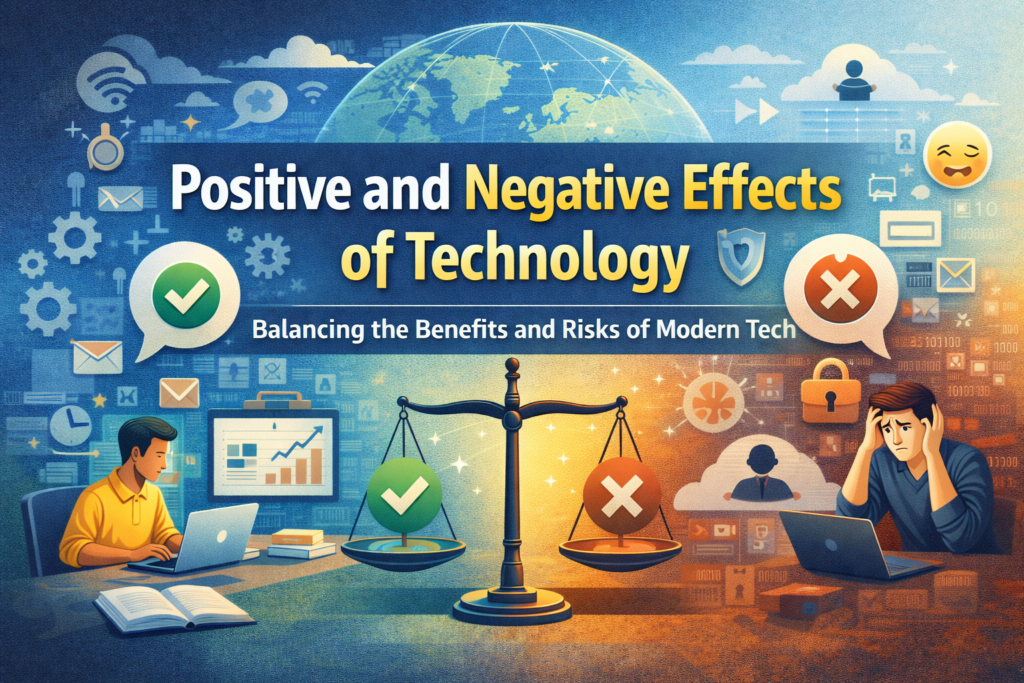
What Are the Positive and Negative Effects of Technology?
Technology has both positive and negative effects depending on how it is used.
Technology itself is neither good nor bad. Its impact depends on usage, context, and awareness. When used properly, technology supports learning, productivity, and communication. When used without control, it can create challenges related to health, privacy, and dependency. A balanced understanding is necessary to evaluate technology realistically. This topic explains both sides in a neutral and educational manner, which is especially important for students and exams.
Positive Effects of Technology
The positive effects of technology include increased efficiency, better communication, and improved access to information.
Technology improves how tasks are completed in daily life and professional environments. It reduces manual effort and saves time. Communication becomes faster and more reliable across long distances. Access to information expands through digital platforms. These benefits appear in education, healthcare, business, and personal life. Positive effects are observable and measurable, which explains why technology is widely adopted.
Technology and Improved Efficiency
Technology improves efficiency by reducing time, effort, and errors in tasks.
In workplaces, technology automates repetitive activities, allowing people to focus on higher-value work. Systems complete tasks faster and with greater accuracy. In daily life, digital services simplify routines such as banking, payments, and communication. Errors decrease because processes are standardized. Efficiency also means better use of resources. These improvements make systems more reliable and productive.
Technology in Communication and Information Access
Technology improves communication by enabling fast and global information sharing.
Communication tools allow instant messaging and information exchange. Distance is no longer a major barrier. Knowledge becomes accessible through online platforms and digital libraries. People stay informed through news and educational resources. Awareness increases as information spreads quickly. Improved communication strengthens social, academic, and professional connections.
Negative Effects of Technology
Despite its benefits, technology can also have negative effects when used excessively or irresponsibly.
Negative effects do not cancel the advantages of technology, but they highlight important risks. Common concerns include dependency, privacy issues, and health impacts. A neutral discussion of these effects helps create realistic understanding. Recognizing limitations supports responsible and informed use.
Technology Dependency and Overuse
Overdependence on technology can reduce problem-solving skills and independence.
When people rely too heavily on technology, basic skills may decline. Excessive screen time can reduce attention span and concentration. Dependency may affect creativity and independent thinking. Productivity can suffer when tools replace judgment. Balanced usage helps maintain skills and independence. Awareness is key to preventing overuse.
Privacy and Security Concerns
Technology can create privacy risks due to data collection and digital surveillance.
Digital systems collect large amounts of personal data. Improper handling can lead to misuse or data breaches. Online platforms may expose users to security risks. Privacy concerns increase with constant connectivity. Awareness and responsible system design help reduce risks. Privacy remains one of the major challenges of modern technology.
Impact of Technology on Health and Social Life
Excessive technology use can affect physical health and social interaction.
Long screen time may reduce physical activity and affect posture and overall health. Social interaction can decrease when digital communication replaces face-to-face contact. Isolation may increase if balance is missing. Technology influences daily routines and behavior patterns. Healthy use supports both physical well-being and social relationships.
Why Balanced Use of Technology Matters
Balanced use of technology helps maximize benefits while reducing negative effects.
Responsible usage ensures efficiency without harm. Education plays an important role in teaching balance. Awareness helps users set limits and make informed choices. Balanced use supports productivity, health, and well-being. Technology should support goals, not replace judgment. This approach strengthens long-term positive impact.
Why This Topic Is Important in Education and Exams
This topic is important in education because it teaches both benefits and risks of technology.
Educational systems emphasize balanced understanding. Exam questions often test advantages and disadvantages together. Students are expected to identify both sides clearly. This topic builds critical thinking and avoids one-sided views. Balanced answers demonstrate better conceptual clarity and usually score higher in assessments.
Final Summary
In summary, technology has both positive and negative effects, and its impact depends on responsible use.
Technology improves efficiency, communication, and access to information. At the same time, it creates challenges related to dependency, privacy, and health. A balanced understanding helps ensure that benefits outweigh risks. Responsible use supports better personal and social outcomes.
FAQs
Technology improves efficiency, communication, and access to information.
Negative effects include dependency, privacy risks, and health issues.
Because it reduces risks while allowing people to benefit from technology.