
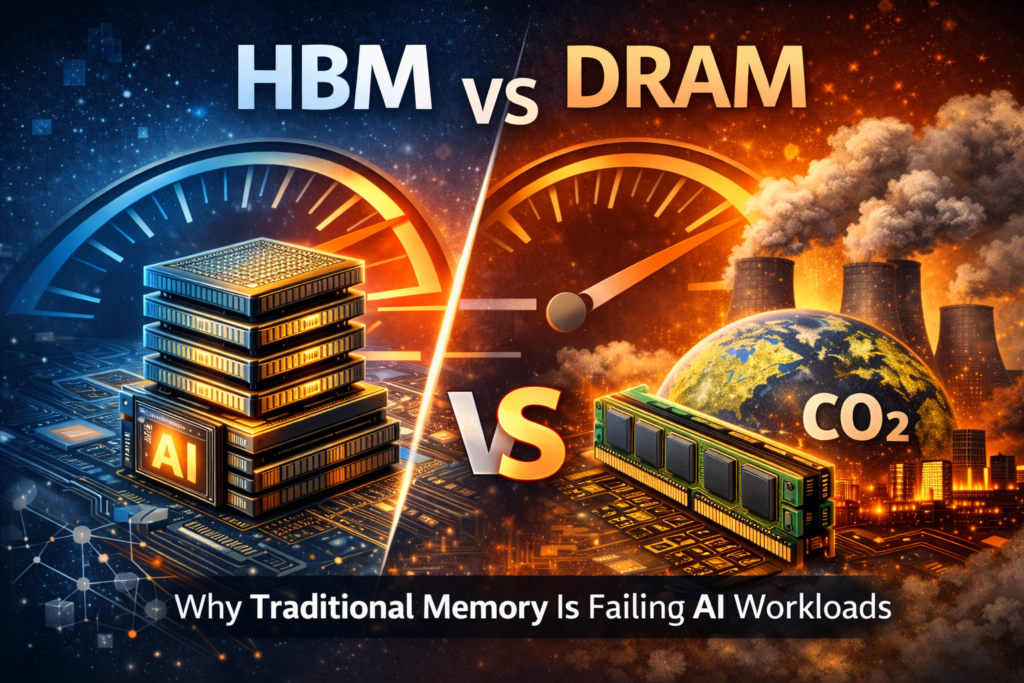
Introduction: The Silent Crisis Inside AI Systems
The AI memory bottleneck refers to a growing gap between how fast processors can compute and how slowly memory systems can deliver data.
Modern AI systems look powerful from the outside. Massive GPUs, trillion-parameter models, and data centers filled with advanced silicon suggest limitless progress. However, inside many of these systems, structural inefficiencies are emerging. Compute units are sitting idle, power is being consumed without productive work, and performance gains are no longer proportional to hardware investment.
This problem is not caused by weak GPUs. It exists because memory cannot keep up with compute. As AI models grow larger and more parallel, the ability to move data efficiently has become more important than raw processing speed.
This imbalance is known as the AI memory bottleneck. It is the reason the debate around HBM vs DRAM matters. The question is no longer which memory is cheaper or more common, but whether traditional memory architectures are fundamentally mismatched to how AI workloads operate. For a broader system-level explanation of how memory shapes modern AI infrastructure, explore our detailed guide on High Bandwidth Memory in AI.
What Is DRAM and How Does It Work?
Dynamic Random Access Memory (DRAM) is a general-purpose memory technology designed for low-latency, sequential data access in traditional computing systems.
Traditional DRAM was designed decades ago, long before AI workloads existed. Its core assumptions were simple: memory requests would be relatively sequential, latency would matter more than total throughput, and a small number of CPU cores would access memory at any given time.
This design worked extremely well for operating systems, databases, web servers, and everyday applications. DRAM sits on memory modules, connected to processors through relatively narrow channels on the motherboard. Over time, DRAM performance improved mainly through higher clock speeds and smaller transistors.
The problem is that DRAM does not scale well when workloads demand massive parallel access. Physical limits such as heat, power consumption, and signal integrity make it difficult for DRAM to deliver the kind of sustained bandwidth that modern AI systems require.
AI Workloads Ki Memory Needs
AI workloads require memory systems that can deliver large volumes of data in parallel rather than serving small requests quickly.
AI workloads behave very differently from traditional software. Neural networks operate on large matrices and tensors, where thousands of operations occur simultaneously. Every one of those operations needs data at the same time.
During AI training workloads, models repeatedly read and update massive parameter sets. These parameters are accessed in parallel across many compute units. In this environment, memory throughput becomes far more important than memory latency. Within modern memory hierarchy design, bandwidth determines whether compute resources remain fully utilized or become memory-bound.
This is where traditional DRAM struggles. It can respond quickly to individual requests, but it cannot sustain the massive parallel data flow that AI workloads demand. As a result, memory becomes the limiting factor long before compute resources are fully utilized.
The AI Memory Bottleneck Explained
The AI memory bottleneck occurs when compute resources are available but memory cannot supply data fast enough to keep them active.
Two memory characteristics matter most here. Memory latency measures how long it takes for data to arrive, while memory throughput measures how much data can be delivered per second. Traditional DRAM is optimized for latency. AI systems depend on throughput.
When thousands of GPU cores request data at the same time, DRAM cannot serve them efficiently. Requests are serialized, queues form, and compute units enter a state known as compute starvation — a condition where expensive processors wait idly because memory throughput cannot match parallel compute demand.
This is why adding more GPUs does not always improve AI performance. Without addressing the underlying system bottleneck, additional compute simply increases power consumption without proportional performance gains.
Why HBM Is More Efficient Than DRAM for AI
High Bandwidth Memory (HBM) is more efficient than DRAM for AI because it is designed to deliver massive parallel memory throughput close to the processor.
The most important difference in the HBM vs DRAM comparison is proximity. HBM is on-package memory, placed directly next to the AI chip. This drastically shortens data paths and enables extremely wide memory interfaces.
HBM also changes design priorities. Instead of optimizing for low latency, it prioritizes throughput and parallelism. By using stacked memory and ultra-wide buses, HBM delivers enormous bandwidth without relying on extreme clock speeds.
This makes HBM ideal for high performance computing and AI accelerators, where thousands of compute units must be fed simultaneously without wasting energy.
HBM vs DRAM: Speed, Power, and Bandwidth Comparison
The difference between HBM and DRAM becomes clear when comparing bandwidth density, power efficiency, and parallel access capability.
Traditional DRAM is placed off-chip, limiting how wide its interfaces can be. As bandwidth increases, power consumption rises sharply. HBM, by contrast, achieves much higher sustained bandwidth while consuming less power per bit.
| Feature | Traditional DRAM | HBM |
|---|---|---|
| Memory placement | Off-chip | On-package |
| Bandwidth | Limited | Extremely high |
| Power per bit | High | Lower |
| Parallel access | Poor | Excellent |
| AI suitability | Low | High |
The core structural difference lies in interface width. Traditional DRAM relies on relatively narrow memory interfaces, while HBM uses ultra-wide interfaces with thousands of data connections, enabling dramatically higher bandwidth without extreme clock speeds.
Cost vs Performance Reality
HBM delivers superior AI performance but at a significantly higher manufacturing and deployment cost than DRAM.
There is no denying that HBM is expensive. Advanced packaging, lower yields, and complex manufacturing processes all contribute to higher costs. DRAM remains cheaper, more flexible, and easier to scale for general-purpose systems.
This is why DRAM is not disappearing. It continues to make sense for CPUs, memory-heavy but low-bandwidth workloads, and cost-sensitive environments.
For AI GPUs, however, the equation changes. When DRAM limitations prevent systems from scaling, cost savings lose relevance. HBM is chosen not because it is cheap, but because it enables AI systems to function at scale.
Is HBM Replacing DRAM? The Future Outlook
HBM is not replacing DRAM entirely, but it is increasingly replacing DRAM in performance-critical AI memory paths.
The future points toward hybrid memory architectures. HBM will handle high-bandwidth AI workloads, while DRAM will continue to provide capacity and flexibility where bandwidth demands are lower.
As AI models grow, traditional DRAM will play a smaller role in performance-critical workloads. AI-specific hardware will rely more heavily on memory architectures designed for parallelism and throughput.
HBM is not a temporary trend. It is a structural response to how AI computes.
Conclusion: Why Traditional Memory Is Failing Modern AI
Traditional DRAM is failing modern AI not because it is poorly designed, but because it was never meant for massively parallel workloads.
The HBM vs DRAM discussion is ultimately about architectural fit. AI workloads demand sustained high-bandwidth data delivery at scale. Traditional DRAM architectures struggle to meet those structural demands.
Frequently Asked Questions About HBM vs DRAM
What is the main difference between HBM and DRAM?
The main difference is that HBM prioritizes extremely high bandwidth and proximity to compute, while DRAM is designed for low-latency, general-purpose computing.
Why does DRAM create a memory bottleneck in AI workloads?
DRAM cannot deliver enough parallel data to keep thousands of AI compute cores busy, causing processors to wait for data instead of computing.
Is HBM better than DRAM for AI GPUs?
Yes, HBM is better for AI GPUs because it provides much higher sustained memory bandwidth with better power efficiency.
Is HBM replacing DRAM completely?
No, HBM is replacing DRAM only in performance-critical AI workloads, while DRAM is still widely used for general computing and capacity needs.
Which memory is best for large-scale AI training?
HBM is the best choice for large-scale AI training because memory bandwidth, not compute speed, becomes the primary performance limit.