
Generative AI vs Machine Learning: What’s the Real Difference?
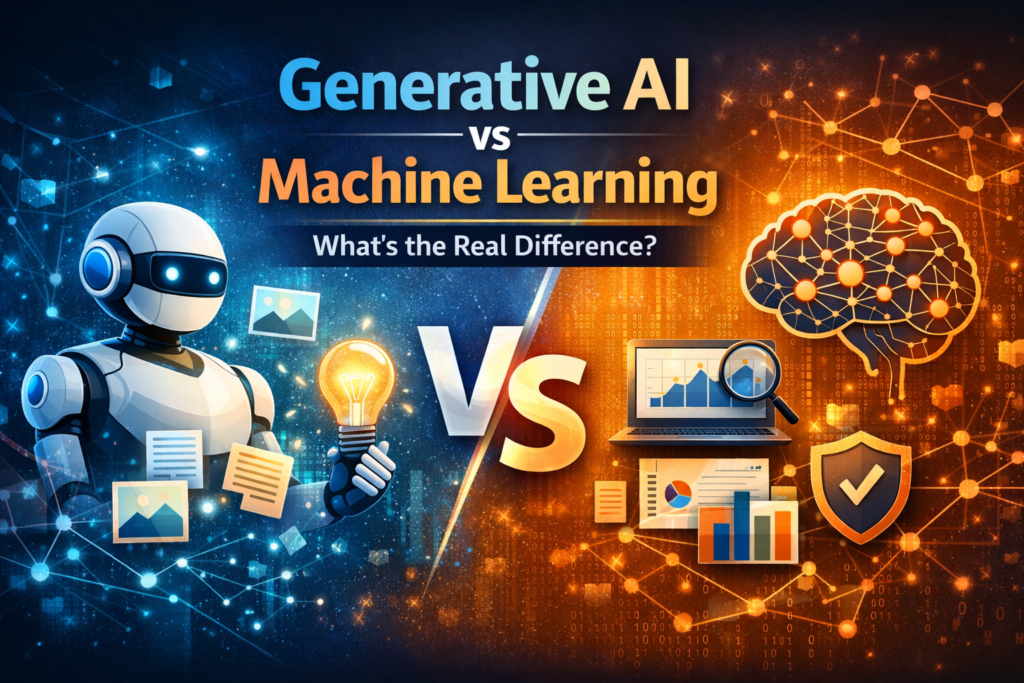
Generative AI and machine learning are both branches of artificial intelligence, but they are used for very different purposes. Machine learning focuses on learning from data to make predictions or decisions, while generative AI focuses on creating new content such as text, images, or audio.
If you’ve seen these terms used interchangeably online, you’re not alone. Many articles blur the line between them, which makes things confusing for beginners and non-technical readers. This guide clears that confusion by explaining how each works, where they are used, and how they are connected, using simple language and real-world examples.
What Is Machine Learning?
Machine learning is a type of artificial intelligence that learns from data to make predictions, classifications, or decisions without being explicitly programmed.
In simple terms, machine learning systems analyze historical data, identify patterns, and use those patterns to make predictions about new data. The more data they process, the better they usually become at their task.
Common machine learning examples include spam email detection, product recommendations on shopping websites, fraud detection in banking, and image recognition systems. These systems are designed to answer questions like “Is this spam?” or “What is the most likely next action?”
Machine learning often relies on approaches such as supervised learning and unsupervised learning, where models are trained using labeled or unlabeled data to improve accuracy over time.
What Is Generative AI?
Generative AI is a type of artificial intelligence designed to create new content such as text, images, audio, or code based on patterns learned from training data.
Instead of predicting outcomes, generative AI produces something new. For example, it can write an article, generate an image from a text prompt, or create lesson plans based on a topic. This is why generative AI is often associated with creativity and automation.
Generative AI systems are commonly built using large language models and deep learning techniques. They don’t “think” like humans, but they are very good at recognizing patterns in language, images, or sound and recreating similar outputs in new ways.
Core Difference Between Generative AI and Machine Learning
The core difference is that machine learning analyzes data to predict outcomes, while generative AI uses learned patterns to create entirely new outputs.
A simple way to understand this is:
- Machine learning helps systems decide or classify.
- Generative AI helps systems create.
For example, machine learning can predict whether a customer will buy a product, while generative AI can write the marketing copy for that product. Both rely on data, but their goals are different.
How Machine Learning Works (High-Level)
Machine learning works by training algorithms on large datasets to recognize patterns and make predictions based on new inputs.
During training, a machine learning model adjusts itself to reduce errors and improve accuracy. Over time, the model becomes better at identifying relationships within the data. This process is widely used in predictive models where consistency and reliability matter more than creativity.
Machine learning systems are especially useful in situations where decisions need to be made quickly and repeatedly, such as recommendation engines or automated risk analysis.
How Generative AI Works (High-Level)
Generative AI works by learning patterns in existing data and then generating new content that resembles what it has learned.
These systems use deep learning and neural networks to understand how words, images, or sounds are structured. When given a prompt, the model predicts what should come next based on probabilities, creating outputs that feel natural and coherent.
This is why generative AI is effective for tasks like writing, design, brainstorming, and content generation, even though it may sometimes produce inaccurate or incomplete information.
Real-World Examples Compared
Both machine learning and generative AI are used in real-world applications, but they solve different types of problems.
Machine learning examples include credit scoring systems, medical diagnosis support tools, recommendation algorithms, and demand forecasting. These systems focus on accuracy and decision-making.
Generative AI examples include writing articles, creating images, generating study materials, drafting emails, and producing code snippets. These tools focus on creativity, speed, and flexibility.
Understanding these differences helps businesses, educators, and individuals choose the right technology for the task at hand.
In education, AI tools for teachers often combine machine learning for assessment insights and generative AI for lesson planning and content creation.
When to Use Generative AI vs Machine Learning
Machine learning is best for prediction and analysis, while generative AI is best for creativity, automation, and content creation.
If the goal is to analyze data and make reliable decisions, machine learning is usually the better option. If the goal is to create new content or speed up repetitive creative tasks, generative AI is more suitable.
In many modern AI systems, both technologies are used together to deliver better results.
Is Generative AI Built on Machine Learning?
Yes, generative AI is built on machine learning techniques, making it a specialized subset rather than a replacement.
Machine learning existed long before generative AI became popular. Generative AI simply extends machine learning by focusing on content generation instead of prediction. This means the two technologies are connected, not competing.
Pros and Cons of Both Technologies
Both technologies offer advantages and limitations depending on how they are used.
Machine learning is reliable, structured, and well-suited for decision-making tasks, but it is limited when creativity is required.
Generative AI is flexible, creative, and time-saving, but it can sometimes generate incorrect or misleading outputs and requires careful oversight.
Understanding these trade-offs helps users apply each technology responsibly.
Frequently Asked Questions
People often ask whether generative AI and machine learning are the same and which one is better to learn first.
Is generative AI better than machine learning?
No. Each serves a different purpose and is useful in different scenarios.
Are they the same thing?
No. Generative AI is a specialized type of machine learning focused on creating content.
Is ChatGPT generative AI or machine learning?
It is an example of generative AI built using machine learning techniques.
Can beginners learn generative AI first?
Yes, especially at a conceptual level, before moving into technical details.
Final Thoughts
Generative AI and machine learning are complementary technologies that serve different purposes within modern AI systems.
Machine learning helps systems learn from data and make decisions, while generative AI helps systems create new content. Understanding the difference allows individuals and organizations to use artificial intelligence more effectively and responsibly.